The whole family go down to the beach for a bonfire before dawn. They cook kumara (sweet potato) and wait for the Matariki star-cluster to rise over the horizon. Nanny tells the children several stories and legends of Matariki. ’Some people say that Matariki is made up
 of the seven houses of the gods,
and that people’s spirits go there when they die’ said Nanny, wiping tears from her face. They eat their kumara and bread by the fire on the first morning of the Maori New Year.
This is a good story for showing celebrations within different cultures. The children ask their mother which of the many Matariki legends they should believe.
‘Well,’ said Mum, ‘Think of the story that feels right in your heart. That is the story for you.’ Bruce Potter’s pictures of the stars and the family on the beach are dramatic.
Note: Matariki is also known as the Pleaides, a small cluster of stars. From a New Zealand viewpoint, Matariki vanishes in the east about mid-April, then reappears about the end of May or later, above the north-east horizon, before dawn. The return of Matariki marks the beginning of the Maori New Year. Traditionally the Maori counted seven stars, sometimes described as Matariki and her six daughters. The smell of the food prepared by the watching people was said to revive Matariki, who was weak and hungry after her journey in the darkness.
2. Celebrating Matariki Libby Hakaria, Reed (2006) This splendidly readable book uses the Matariki constellation as a framework for a range of information about the stars, Maori seasons, fishing, hunting, gardening and legends.
Matariki, known to the Greeks as the Pleiades, marks the beginning

of the Maori year, when it rises above the horizon in early June. Traditionally the first full moon after the rising of Matariki was a time for feasts and celebrations and the hunting and preserving of birds. A wide range of activities, including telescope-making, kite-flying and cooking are included. (The recipe for Kumara Chowder is excellent.) The book’s design is attractive, with clear double-page spreads, and good use of colour and fact-boxes. The text is well laid-out and very readable.
In a nice touch, the Japanese name for Matariki, Subaru, is noted with a picture of a New Zealand rally team in their Subaru. Several songs about Matariki are included in an accompanying CD, and the lyrics are printed in the book in both English and Maori.
This book fills a gap in libraries and schools, providing background material for fictional books on Matariki. At the same time Celebrating Matariki is so attractively presented that it can be read for simple enjoyment.
3. Glow Worm Night Don Long, Tracy Duncan (ill.) Reed (2004) This book is about a family observing the Maori traditional New Year, marked by the first appearance of the group of stars, Matariki. A young girl tells how she goes with her father and brother into the nearby bush late at night. They switch off their torches and look at the stars.

Dad points out Matariki the Pleaides).
After that, everyone looks for glow-worms.
Then, there they are – glowing along the stream. Glow-worms! Puratoke. They see some nocturnal creatures, such as the morepork (native owl) and freshwater crayfish.
Later Mum gives everyone Milo and tucks them into bed. ‘Sweet glow-worm dreams,’ she whispers as she switches off the light.
As Tracy Duncan’s handsome colour illustrations make clear, Dad is Maori and Mum is Pakeha (non-Maori). Some of the dialogue is in Maori, as when Dad says, Tino makariri before everyone puts coats on to keep out the cold (makariri). The context and the illustrations always make the meaning clear to non-Maori speakers.
Tracy Duncan’s illustrations always reward careful study. There are creatures, such as the Puriri moth to be spotted in the bush scenes, and books in the house. The young girl is reading Taniwha, by Robyn Kahukiwa.
Note: Matariki, also known as the Pleaides, is a small cluster of stars. From a New Zealand viewpoint, Matariki vanishes in the east about mid-April, and then reappears about the end of May or in June, above the north-east horizon, before dawn. The return of Matariki marks the beginning of the Maori New Year. Traditionally the Maori counted seven stars, sometimes described as Matariki and her six daughters.
4. Scoop and Scribe Search for the Seven Stars of Matariki
Tommy Kapai Wilson, Rob Turvey (ill) Random House (2009)
Tommy Kapai Wilson was a newspaper columnist and children’s author who, in 2008, wrote a children’s action serial for the NiE (Newspapers in Education) newspaper educational supplement. It was revised and reprinted as a book in 2009. Scoop and Scribe search for the Seven Stars of Matariki is slim on characterisation but is certainly a fast-moving fantasy adventure.
After a tip-off by a mysterious tohunga named Koro Whetu, ace junior reporters

Scoop and Scribe are commissioned to seek the seven lost stars which form the constellation Matariki (also known as the Pleiades or Subaru).
Whetu guides the intrepid news-crew as they travel around New Zealand collecting the stars, which have been stolen by a kea (mountain parrot). A prominent local feature plays an important part in each chapter, so that the stolen statue of Pania of the Reef is recovered in Tauranga, while at Katikati, Donald Paterson’s sculpture Barry, (the only NZ statue to feature a newspaper) assists in the search.
With its many Maori characters and references, the story is accompanied by a Maori-English glossary and some factual material about Matariki and the Maori New Year.
Rob Turvey’s colour illustrations help make this an attractive presentation of a light-hearted fantasy quest, with an appeal for young male readers.
5. The Seven Stars of Matariki Toni Rolleston-Cummins Nikki Slade-Robinson (ill.) Huia (2008)The Maori New Year is traditionally marked by the rising of the star cluster Matariki (also known as Subaru and the Pleiades). There are many Maori legends about Matariki.
This picture book retells a Maori tradition of Matariki’s origins, from the Bay of Plenty region of the North Island, and introduces some associated customs and rituals.
Mitai, who lived at Maketu (near modern Whakatane) had the power
to change himself into a bird.
When his seven elder brothers were entranced by seven beautiful golden-haired women, they ignored Mitai’s warning that the seven women were really patuparaeihe (fairy folk).
Mitai overheard these women (who could turn themselves into fantails) plotting to starve their new husbands to death. He persuaded his brothers – now gaunt with hunger – to weave nets so they could capture their seven murderous wives while they were still in fantail form. Then Mitai flew up and handed the captive fairies over to Urutengangana, god of the stars, who placed them far from Earth. Once a year, the god allows their golden beauty to shine out. So at each winter solstice, the seven stars of Matariki appear above the horizon.
6. Little Kiwi’s Matariki
Nikki Slade Robinson (text and ill) Duck Creek Press (2016)The little Kiwi and her friends discover the joy of Matariki in this charming picture book. A beam of moonlight wakens little kiwi. The tiny kiwi realises the time has come and runs through the bush in the darkness. One by one, she wakens her sleeping friends and tells them to come and see something exciting.
‘Can you feel it coming?’ Before long she has a procession of creatures (including

katipo spider, tui, weka and a family of ruru (owls)) trailing
behind her. Young readers will enjoy the parallel to Chicken-Licken.
Finally they all arrive at the beach and stand in the moonlight, as Matariki rises. They celebrate the New Year in the traditional Maori ways. For example, the katipo weaves a silken kite and flies it as part of the fun and games.
‘Matariki?’ said Tui, ‘Time for music and dance!’ He sang to the stars. The author’s illustrations are stylised and streamlined representations of New Zealand plants and birds. They are also witty. The tiny owlets are all eyes and the weka (woodhen) is a speedster.
Little Kiwi’s Matariki also includes an explanation of Matariki – it's origins, traditions and how it is celebrated today. The constellation is shown, with the Māori names for each star. The story also offers what Nikki Slade Robinson describes as ‘
a gentle introduction to te reo within the English text.’
Winner Best Picture Book of 2016 in the New Zealand Book Awards for Children.
Shayne's reading of Little Kiwi’s Matariki is available on YouTube
7. The Seven Kites Of Matariki Calico McClintock, Dominique Ford (ill.) Scholastic (2016)
The Seven Kites of Matariki is a modern tale about Matariki. It explains why the star cluster known as Matariki can be seen in an early morning winter sky, low on the eastern horizon.
In a Maori village, seven sisters are making kites to celebrate the arrival of the new year, just as their mothers and grandmothers had before them.
Each girl makes a different kite using local materials;
the youngest sister, Ururangi makes ‘a many-
coloured kite with eyes of paua shell’.
The seven girls climb a hill to fly their kites and argue with each other about whose kite will fly highest.
‘My kite is the best.’ Unfortuately there is no wind on the hilltop and so the seven girls wrap themselves in their cloaks and wait beneath a giant puriri tree. Exhausted, they soon fall asleep. When the wind blows from the east, crying ‘
Wake up. Wake up’ they don’t hear it. But their kites lift up in the wind, which carries them fluttering up into the sky.
Much later, Ururangi wakes up, sees her kite gone and awakens her sisters to tell them of their loss. Her six sisters look out into the morning sky and see their six kites flying there like the new year stars. The six head back to the village for kai (food).
Ururangi remains behind searching the skies for her kite. She is rewarded by being the first to see the seven stars of Matariki appear.
Dominique Ford’s beautiful illustrations capture the symbolism of the story well. Each kite is based on a traditional design and the colours are matched to the appropriate plants and shells used in making them.
Note: Ururangi is the Matariki star traditionally associated with the wind.
Shayne's reading of The Seven Kites of Matariki is on YouTube.
8. Tawhirimatea: A Song for Matariki June Pitman-Hayes, Kay Merewether (ill.) Scholastic (2017)''Tāwhirimātea, blow winds, blow.’This picture book (which doubles as a song book) shows the world through the eyes of a Maori family. As they gather shellfish, plant a tree, and have a family picnic, their words are reminders of the importance of the natural world about them. The seasons pass by, until the rising of the stars of Matariki signal the beginning of a new year.
‘Our universe is an amazing nature show.’
The second part of the book consists of the same lyrics, this time in Maori.
‘Now, let’s sing it in Maori.’
The Maori words are by Ngaere Roberts.
‘Ko te ao nui, he Whakaari, miharo.’
The watercolour illustrations by Kat Merewether perform a double service. They show the family along with the birds, fish and plants in their natural surroundings but they also illustrate the traditional Maori pantheon of supernatural beings. Tāwhirimātea is the god of the winds, and his face appears, cheeks puffed, among the clouds, while Ra provides the sunshine and Ua the rain.
Each picture has its secret for young readers to spot.
On an accompanying CD, both versions of the song are performed by June Pitman-Hayes with her own ukulele accompaniment. There is also an instrumental track for young vocalists to sing along to.
9. Stolen Stars of Matariki Miriama Kamo, Zac Waipara (ill.) Scholastic (2018)
Stolen Stars of Matariki is a splendid picture book bringing some of the Māori traditions associated with Matariki into a 21st Century context.
Young Te Rerehua and Sam are visiting their grandparents at one of Canterbury’s important Maori traditional sites, Te Mata Hapuku (Birdlings Flat), a massive shingle spit and traditional eeling site. It is “a magical wild, windy place,” where they can gather agates on the beach. While Poua (grandfather) is gaffing eels at night, the children lie on the shingle with Grandma, looking up at the stars. One night Grandma spots something strange; there are two stars missing from the Matariki cluster. The patupaiarehe (fairy folk) have been stealing stars again.
Their plan is to hide the stars beneath the
shingle, to be smashed to pieces, so they can wear the fragments on their clothing.
Using Grandma’s knowledge (and Poua’s gaff) Te Rerehua and Sam manage to infiltrate and outwit the mischievous patupaiarehe, and restore the kidnapped stars to their rightful place in the heavens.
Miriama Kamo has written a beautifully-styled story which has the simplicity and power of traditional folk tales.
Zak Waipara has produced magnificently atmospheric illustrations, with richly patterned and coloured backgrounds. He has successfully achieved the difficult task of mixing human and supernatural characters, as well as the technically difficult feat of portraying night-time activities. The result is a handsome and appealing picture book.
Stolen Stars of Matariki now joins a select mini-library of celebrations of Matariki.
These include Matariki (2003), Glow-Worm Night (2004), The Seven Stars of Matariki (2008), and Tawhirimatea: A Song for Matariki (2017).
In 2018 Scholastic also published a Maori language edition, Nga Whetu Matariki Whanakotia, with the Maori translation by Ngaere Roberts.
Note: The rising above the N.E. horizon (in May-June) of the star cluster Matariki marks the Maori New Year. While it is common to count seven stars forming the cluster known as Matariki (or Subaru or Pleaides) some Maori identify nine. Their names are Matariki, Pōhutukawa, Waitī, Waitā, Waipuna-ā-rangi, Tupuānuku, Tupuārangi, Ururangi, and Hiwa-i-te-rangi. - info from Christchurch Library Website: The Nine Stars of Matariki
During the 2020 Covid-19 Lockdown, musicians from the New Zealand Symphony Orchestra provided a musical background, as Miriama Kamo read The Stolen stars of Matariki aloud. The composer of the original music is Claire Cowan.
Website: https://www.youtube.com/watch?v=sWWcM0BWwwc
10. Together in Love: a Legend of Matariki Xoë Hall (text & ill.) Teacher Talk (2018)
This picture book is a brief retelling of the Māori creation legend telling how the children of the gods Ranginui and Papatūānuku force them apart to let in the light and allow the world to flourish. Tāwhirimātea, god of the wind, angered by this action of his sibling gods, tears out his lightning-bolt eyes and throws them up into the sky. They explode to become
the star cluster of the Matariki constellation, which
is now the harbinger of the Māori New Year.
When Māori come together at new year, to celebrate, they tell this story to their children as their parents did before them.
Xoë Hall’s simple retelling is nicely matched by her colour illustrations. She uses bright colours and traditional Maori designs to make the various gods distinctive figures.
Shayne’s reading of Together in Love is available on YouTube:
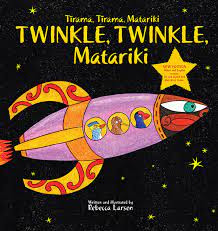
11. Twinkle, Twinkle, Matariki Rebecca Larsen (text and ill.) Imagination Press (2019)Whistle like the windy sky,
Sprinkle showers passing by. This charming picture book is both simple and useful. Within an over-arching story format of three native birds (Hoiho, Pukeko and Kiwi) touring outer space in a rocket, it presents a series of simple songs (with a familiar tune) about such things as our food, how it is grown, the seasons, the weather,
and of course the stars that act as markers.
Rub your puku round and round
Food we’ve grown, caught or found. Bright colourful illustrations by the author match the simple songs, which are provided in both Maori and English. Particularly pleasing is the spaceship which is decorated with Maori motifs, an inspiration for young kiwi astronauts.
A pictorial Glossary ensures that all is explained.
These songs scan well and provide young people with useful vocabulary. The words are provided in both English and Maori. (Translators: Tania Solomon, Justin Kereama).
A bonus CD has the songs sung in both English and Maori by Paul Inia. (Music by Richard Larsen.)
Twinkle, Twinkle, Matariki is the perfect book for a kindergarten or kura kaupapa sing-along in English or Te Reo.
12. The Promise of Puanga: A Story for Matariki Kirsty Wadsworth, Munro Te Whata (ill), Scholastic (2019) ‘Hana and Puanga did everything together.’ The Promise of Puanga is a picture book about two friends, and the fun they have together, watching new-born animals in spring, swimming in summer and riding their bikes through the leaves in autumn.
A problem in their area is that winter comes without warning, killing the un-gathered crops. When Hana speaks to Puanga about this problem and the need for a warning about the approach of winter, she gets an astonishing confession.
‘I’m really a star,’ Puanga explained. She has left her Matariki cousins in order to ‘explore and go on adventures.’
Hana has never seen the stars of Matariki because of the nearby hills and mountains.
Puanga summons Tāwhirimātea, the guardian of the wind, to take her back up into the sky to be a guardian for Hana’s village.
Tāwhirimātea promises that when Hana sees Puanga shining brightly in the sky, she will know it is time for the people to gather their crops. ‘She is our own special sign,’ says Hana. And so it happens.
Munro Te Whata’s splendid illustrations convey the friendship of the two girls in several charming scenes. His portrayal of Tawhirimatea is equally skilful, bringing together the colour of the night sky, the shape of the nearby mountain and the suggestion of clouds as his hair and beard.
The result is a lovely modern story based on traditional Maori elements.
This picture book, The Promise of Puanga, fills an unusual gap. In recent years some half-dozen New Zealand picture books have been published with stories about the cluster of stars Matariki, the rising of which signals the coming of winter and marks the traditional Maori New Year. What none of these books has mentioned is that in some areas along our western coasts, mountainous terrain prevents sighting of these stars (also known as the Pleiades, Mao or Subaru). The Promise of Puanga tells in story form how this astronomical difficulty was solved for the Maori people living in these western areas by the rising of Puanga (also known as Rigel).
There are Teaching Notes for this book at: The Promise of Puanga
A diagram showing Matariki and Puanga is at: https://teara.govt.nz/en/diagram/14080/puanga
In 2019 Scholastic also published an identical Maori language edition, He Purakau Matariki, Te Ki Taurangi a Puanga.
13. Flit the Fantail and the Matariki Map Kat Quinn (text and ill.) Scholastic (2021)This third picture book in the Flit the Fantail series is written and illustrated by Kat Quin (formerly Kat Mereweather).
We’re lost! Flit and Keri cry. Lured by the moonlight and unable to sleep, Flit has left the safety of his nest and ventured down to the dark forest floor. Flit hopes to capture the moonlight (in order to illuminate his nest). Through the trees, he can see the star cluster known as Matariki.
Tahi, rua, toru, whā, rima, ono, whitu, waru, iwa, he counts. Keri the young kiwi, out foraging, offers to help Flit in his quest. They struggle through the bush and scrub and climb up high but are still unable to reach the moon. The pair realise that they are lost. How can they find their way home?
Ruru the owl sees them huddled together and points to the stars above.
Sometimes those special stars can even guide us home. Flit spots the cluster of nine stars he saw earlier above his home. He carefully pecks nine holes into a kawakawa leaf in the shape of Matariki. Then the two birds make their way home, using the leaf map to follow the Matariki stars. They reach home just before the sun rises. Flit then has a bright idea. Perhaps he can capture the sun and use it to light his nest at night?
The charming colour illustrations are by the author, Kat Quin.
An identical Maori language edition of Flit the Fantail and the Matariki Map was also published by Scholastic NZ in 2021, as Ko Flit te Tirairaka te Mahere Matariki.
14. Daniel’s Matariki Feast Linley Wellington & Rebecca Beyer (text)
Christine Ross (ill) Duck Creek Press. English ed (2014); Māori ed (2015) and combined English Māori and Chinese pinyin ed (2021).
On his first day at kindergarten, Daniel is shy.
He is puzzled that they will be having a feast
because of the stars.
Then he listens to some of the other children
telling stories of the Māori New Year.
At home Daniel tells his mother about the feast and she makes a spicy pumpkin soup using her late mother’s recipe. (This is a subtle reminder that Matariki is also a time for remembering those who have died.) Daniel has fun working in the garden with his new friends and afterwards he enjoys his Matariki feast.
Christine Ross’s illustrations really capture the world of small boys and also give a good idea of how to greet the Māori new year.
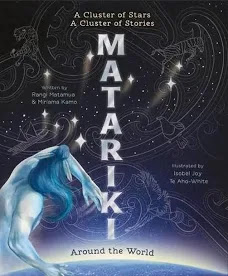
15. Matariki Around the World Rangi Matamua & Miriama Kamo
Isobel Joy Te Aho-White (ill.) 82 pages, hardback, Scholastic (2022)
The subtitle tells it all: A Cluster of Stars, A Cluster of Stories.
Miriama Kamo and Rangi Matamua have gathered stories from around the world that are linked to the distinctive group of stars known to Maori as Matariki. ‘All around the world, the star cluster has different names, different stories, different mahi (jobs), and even different numbers of stars.’ The result is the best book ever written about Matariki.
The first part of Matariki Around the World describes the Māori traditional creation of the
world and has handsome double-page descriptions of the Maori gods and the lunar calendar. There are similar double-page retellings of some Māori traditions concerning the attributes of each of the stars Matariki and her eight children (Pōhutukawa, Tipuānuku, Tipuārangi, Waiti, Waitā, Waipunarangi, Ururangi and Hiwa-i-te-rangi). For example Tipuānuku cares for food grown in the earth, and her brightness gives an indication of how kumara crops will fare in the year ahead.
‘Anā! Te paki o Matariki. Behold! The wonders of Matariki.’
The second part of the book offers some retellings of Matariki stories from other cultures around the world. Not only the well-known Pleiades (Greece) and Subaru (Japan) legends are offered but also a range of stories from Africa, Australia, China, India, Scandinavia and North and South America. All are fascinating but the most interesting are the ones from the Pacific, with the similarities and differences sympathetically examined.
The writing style of this book is remarkable. The text is well researched and culturally sensitive but it is also written in a relaxed and witty style. Here the authors are revealing the Viking name for Matariki: ‘So you would think they’d have a pretty tough-guy name for the Matariki cluster, wouldn’t you? Nope. They called it…ahem…Freya’s Hens. Hens? What? Are hens hardy, battle-scarred warriors?’ (We also learn that some Vikings preferred to think of Matariki as a ladybird because of the insect’s seven spots.) Either way, Freya was the goddess who cared for the spirits of dead warriors. ‘So Freya is pretty cool.’
Writing like this makes for enjoyable reading.
Each story is beautifully illustrated by Isobel Joy Te Aho-White.
Best of all, this handsomely designed book has an excellent index and glossary.
It is a picture book which every home should have.
Trevor Agnew
24 June 2022
The first celebration of Matariki as a New Zealand public holiday.
 Bidibidi Gavin
Bishop
Bidibidi Gavin
Bishop
 ISBN 1869435877