Showing posts with label 2006. Show all posts

Friday, 27 February 2026


Lost World in the City   Bill Nagelkerke


Lost World in the City (2025)
Bill Nagelkerke, 
Copy Press (Nelson), 
Novel, 175 pages Paperback
ISBN 978-0-47375-569-0 

Lost World in the City (2025) is the third volume in a series which Bill Nagelkerke began with The Ghosts on the Hill (2020) and continued in The Roar of the Lion (2025). Each novel stands alone but some of the characters reappear as time passes. The saga which began in 1884 has now reached 1914, with war imminent.


The narrator is Nell aged eleven. She reads widely and is irritated that all the adventure stories feature men with beards who have all the fun. ‘It’s not fair on girls,’ complains Nell to her brother Sandy, ‘Because there’s never a place for us in their expeditions. We have to wait around at home.’ These two young readers of Verne’s Journey to the Centre of the Earth and Conan Doyle’s The Lost World, live in Christchurch’s eastern suburb of Aranui, near Wainoni Park. Their father travels by tram each day to work in the city library. Meanwhile their mother is concerned that war is about to break out in Europe; she was deeply disturbed by the death of her brother Hugh in the South African War a decade earlier.

Nell and Sandy are sympathetic and ask their father what they can do.

‘We just have to keep on reminding her that she still has us, as well as the new baby on the way, and that it’s possible to be happy at the same time as being sad,’ Papa replies.

‘That’s hard,’ Sandy says.


Nell is inspired by attending a public lecture given at the library by a successful adventure story author, Jack Lytle (whose career began in The Roar of the Lion). She persuades her brother to come with her into Wainoni Park in search of a moa. The amusement park has been closed to the public since its owner Professor Alexander Bickerton returned to England but Nell is sure she has heard strange sounds from there.

What they find is much more interesting and puzzling. Can a moa eat a small boy? How can Nell and Sandy have met and talked to Professor Bickerton when he is still overseas? Has Nell possibly found a way of fulfilling her dream of flying over Christchurch?

Nell is beginning to believe her Mama’s warning ‘that we get so lost in stories that one day Sandy and I won’t be able to tell the difference between what’s real and what’s not.’  What is certain, however, is that the baby is arriving just as war is declared.  Their harried father sends them out to play in the street. (In those days, we are reminded, babies were usually born at home, and streets were slightly less dangerous places.)

 Of course, Nell and Sandy head straight for Wainoni Park again. What they find there, this time, is truly remarkable.


Bill Nagelkerke has written a charming and readable story that recreates the final days of the Wonderland amusement Park created by the talented Professor Bickerton. There is a real sense of wonder as past and present blend. Henry, from The Roar of the Lion, makes a surprising and uplifting appearance. Will he achieve his dream of zoo-keeping, or will he join the army? The differing views towards warfare held during the opening days of the Great War are well conveyed, offering plenty of scope for a sequel.

A Historical Note includes research advice for young readers who want to experience some of the magic of Bickerton’s Wainoni.


Trevor Agnew 

Jan 2026 [Review 3813]


The Roar of the Lion  Bill Nagelkerke


The Roar of the Lion
Bill Nagelkerke
Novel 126 pages (2025)
Paperback
ISBN 978 0 473 75359 7


 Bill Nagelkerke has a flair for capturing a tiny moment in our history and bringing it to vibrant life by re-examining it from a young person’s viewpoint. The Roar of the Lion (2025) is the second volume in a series which began with The Ghosts on the Hill (2020) and continues in Lost World in the City (2025). Each novel stands alone but some of the characters reappear. The city of Christchurch is, of course, the main character. As the garden city prepares for its first International Exhibition, from 1906 to 1907, wooden towers rise on Hagley Park and two young boys are fascinated by the chance of seeing some exotic animals. 

 The class differences of Edwardian Canterbury are subtly sketched in. Henry Lytle lives with his father, Jack, in a humble boarding house in Cranmer Square and goes to Christchurch East School. Leo Church’s family own a large property in Papanui Road and he attends Christ’s College as well as being a cathedral chorister. Leo has a season pass to the exhibition, of course, but Henry has to find a less costly way in. Excited by rumours of lions being on display, Henry is surprised when he learns from his reporter father that it is actually a group of captured sea-lions which will be on display. 

 Many news items were published about events at the exhibition and some fascinating extracts are included in the text, all of them, naturally, attributed to Jack. ‘A most pronounced odour of the sea pervading portions of the Acclimatisation Gardens, proclaims the temporary abiding place of the oddities of fur and feather brought up by Captain Bollons.’ Young readers will be amused by the pompous style but Henry is a sterner critic. ‘You managed to fit in a lot of ‘ps’ in the first sentence,’ he warns his father. 

Jack is more interested in writing novels than journalism, but will he succeed? Jack’s friendship with William, the Acclimatisation Society’s animal keeper, means that Henry gets a part-time position as assistant caretaker of the wildlife enclosure at Victoria Lake. (William, whose sister Elsie appears in The Ghosts on the Hill, is also able to give Henry a Southern Māori view of the famous pā created for the exhibition.) Henry hopes for a career as a zoo-keeper but he finds life caring for the fish-eating captives is not easy. The names which some of the sea-lions are given - Bumper, Bully and Sneak – hint at their behaviour. 

Henry’s most alarming moment comes when the largest of them, Jumbo, manages to break out of the enclosure. Can Leo and Henry find a way to get him back? Equally daunting are Henry’s visits to his grandmother, who is constantly railing against the decline in modern manners. Bill Nagelkerke has a lovely writing style with a nice touch of humour. Henry finds his chair at Grandma’s New Brighton home very uncomfortable: ‘It was hard and unyielding, much like Grandma herself.’ Henry later takes delight in naming one of his sealion charges Nelly, after her. Jack is horrified, ‘Grandmother must never, ever find out.’ 

 There are also many interesting minor characters including Mr Strong the librarian who dreams of a children’s section, Mr Purfleet the actor who names Leo’s dog Macbeth (because he murders sleep) and Professor Bickerton who is the moving spirit behind the sequel to this volume, Lost World in the City. The Roar of the Lion is an enjoyable historical novel. The author’s Historical Note provides young readers with plenty of ways they can find out more about their own local history. It may even inspire them to write their own stories of the past. 

 Trevor Agnew 
 Jan 2026 [ Review 3814]


The Ghosts on the Hill  Bill Nagelkerke  

The Ghosts on the Hill
Bill Nagelkerke
Ill. Theo McDonald
Cuba Press (2020)
Novel, 81 pages, paperback
ISBN 978 0 995 12336 6


‘You can’t really blame the hills for what happened to Davie and Archie.’
,Yes, I can,, says Elsie.
This novel, like one of the writer’s earlier novels Old Bones (2006), is a gentle story of the supernatural. Elsie (12) an imaginative and observant young girl, living in the Canterbury port of Lyttelton in 1884, is fishing off the wharf. She misses the two boys, Davie and Archie, who once fished from the same wharf but later perished of exposure on the Port Hills. Her fishing friend, Mr James, tells how memorials are to be unveiled where the boys died. His wife, Mrs Annie James, was the last to see Davie and Archie alive and she feels guilt about not stopping them going over the hills when bad weather was threatening.
Elsie’s mother has gathered a bag of baby clothes for her sister, Elsie’s Aunt Priscilla who has just had a baby in Heathcoate. Despite her misgivings about the Port Hills, Elsie offers to walk over the Bridle Path to deliver the clothes.
‘I don’t want to keep on feeling scared.’
The landscape of the Port Hills, as seen by Elsie, is beautifully described.
‘A light wind ripples the tawny tussock grasses.’
Elsie has a nap on the way and dreams of the boys walking over the hills. When she awakens, it is late afternoon and clouds of mist have descended. Elsie is confused and panics. She thinks she hears the music of the patupaiarehe, the fairy folk her Maori father, Henare of Rapaki, has told her about. Then, voices from the fog calm her. Elsie recognises the voices of Archie and Davie.
‘Are you ghosts?’
‘I suppose we must be’.
They tell her that, just as Elsie had helped them, they seem to have stayed long enough to help her. They guide Elsie to safety. Later Elsie and Mrs James go to the unveiling of the memorials and find comfort in what they hear and see there.


This is a very readable junior novel, rich in detail, thought-provoking and thoroughly enjoyable.
Extracts from contemporary newspapers are included, and an Author’s Note identifies the historic characters in the story.
The simple line illustrations in the text are by Theo Macdonald.

Note: Characters from this novel also appear in other novels by Bill Nagelkerke: The Roar of the Lion (2025) and Lost World in the City (2025).


Thursday, 23 June 2022

Books about Matariki


15 books about Matariki


Chosen and described by Trevor Agnew, 24th June 2022

1. Matariki, Melanie Drewery, Bruce Potter (ill) Reed (2003) Puffin (2016) 

The whole family go down to the beach for a bonfire before dawn. They cook kumara (sweet potato) and wait for the Matariki star-cluster to rise over the horizon. Nanny tells the children several stories and legends of Matariki. ’Some people say that Matariki is made up 
of the seven houses of the gods, 

and that people’s spirits go there when they die’ said Nanny, wiping tears from her face.
They eat their kumara and bread by the fire on the first morning of the Maori New Year.

This is a good story for showing celebrations within different cultures. The children ask their mother which of the many Matariki legends they should believe. ‘Well,’ said Mum, ‘Think of the story that feels right in your heart. That is the story for you.’

Bruce Potter’s pictures of the stars and the family on the beach are dramatic.

Note: Matariki is also known as the Pleaides, a small cluster of stars. From a New Zealand viewpoint, Matariki vanishes in the east about mid-April, then reappears about the end of May or later, above the north-east horizon, before dawn. The return of Matariki marks the beginning of the Maori New Year. Traditionally the Maori counted seven stars, sometimes described as Matariki and her six daughters. The smell of the food prepared by the watching people was said to revive Matariki, who was weak and hungry after her journey in the darkness.


2. Celebrating Matariki Libby Hakaria, Reed (2006)

This splendidly readable book uses the Matariki constellation as a framework for a range of information about the stars, Maori seasons, fishing, hunting, gardening and legends.

Matariki, known to the Greeks as the Pleiades, marks the beginning
 of the Maori year, when it rises above the horizon in early June. Traditionally the first full moon after the rising of Matariki was a time for feasts and celebrations and the hunting and preserving of birds. A wide range of activities, including telescope-making, kite-flying and cooking are included. (The recipe for Kumara Chowder is excellent.) The book’s design is attractive, with clear double-page spreads, and good use of colour and fact-boxes. The text is well laid-out and very readable.

In a nice touch, the Japanese name for Matariki, Subaru, is noted with a picture of a New Zealand rally team in their Subaru. Several songs about Matariki are included in an accompanying CD, and the lyrics are printed in the book in both English and Maori.

This book fills a gap in libraries and schools, providing background material for fictional books on Matariki. At the same time Celebrating Matariki is so attractively presented that it can be read for simple enjoyment.


3. Glow Worm Night Don Long, Tracy Duncan (ill.) Reed (2004)

This book is about a family observing the Maori traditional New Year, marked by the first appearance of the group of stars, Matariki. A young girl tells how she goes with her father and brother into the nearby bush late at night. They switch off their torches and look at the stars. 
Dad points out Matariki the Pleaides).

After that, everyone looks for glow-worms. 
Then, there they are – glowing along the stream. Glow-worms! Puratoke. They see some nocturnal creatures, such as the morepork (native owl) and freshwater crayfish. 
Later Mum gives everyone Milo and tucks them into bed. ‘Sweet glow-worm dreams,’ she whispers as she switches off the light.
As Tracy Duncan’s handsome colour illustrations make clear, Dad is Maori and Mum is Pakeha (non-Maori). Some of the dialogue is in Maori, as when Dad says, Tino makariri before everyone puts coats on to keep out the cold (makariri). The context and the illustrations always make the meaning clear to non-Maori speakers.
Tracy Duncan’s illustrations always reward careful study. There are creatures, such as the Puriri moth to be spotted in the bush scenes, and books in the house. The young girl is reading Taniwha, by Robyn Kahukiwa.

Note: Matariki, also known as the Pleaides, is a small cluster of stars. From a New Zealand viewpoint, Matariki vanishes in the east about mid-April, and then reappears about the end of May or in June, above the north-east horizon, before dawn. The return of Matariki marks the beginning of the Maori New Year. Traditionally the Maori counted seven stars, sometimes described as Matariki and her six daughters.


4. Scoop and Scribe Search for the Seven Stars of Matariki  
Tommy Kapai Wilson,  Rob Turvey (ill)  Random House (2009)

Tommy Kapai Wilson was a newspaper columnist and children’s author who, in 2008, wrote a children’s action serial for the NiE (Newspapers in Education) newspaper educational supplement. It was revised and reprinted as a book in 2009. Scoop and Scribe search for the Seven Stars of Matariki is slim on characterisation but is certainly a fast-moving fantasy adventure. 
After a tip-off by a mysterious tohunga named Koro Whetu, ace junior reporters 
Scoop and Scribe are commissioned to seek the seven lost stars which form the constellation Matariki (also known as the Pleiades or Subaru).

Whetu guides the intrepid news-crew as they travel around New Zealand collecting the stars, which have been stolen by a kea (mountain parrot). A prominent local feature plays an important part in each chapter, so that the stolen statue of Pania of the Reef is recovered in Tauranga, while at Katikati, Donald Paterson’s sculpture Barry, (the only NZ statue to feature a newspaper) assists in the search.
With its many Maori characters and references, the story is accompanied by a Maori-English glossary and some factual material about Matariki and the Maori New Year.

Rob Turvey’s colour illustrations help make this an attractive presentation of a light-hearted fantasy quest, with an appeal for young male readers.


5. The Seven Stars of Matariki Toni Rolleston-Cummins Nikki Slade-Robinson (ill.) Huia (2008)

The Maori New Year is traditionally marked by the rising of the star cluster Matariki (also known as Subaru and the Pleiades). There are many Maori legends about Matariki.
This picture book retells a Maori tradition of Matariki’s origins, from the Bay of Plenty region of the North Island, and introduces some associated customs and rituals.

Mitai, who lived at Maketu (near modern Whakatane) had the power
 to change himself into a bird.

When his seven elder brothers were entranced by seven beautiful golden-haired women, they ignored Mitai’s warning that the seven women were really patuparaeihe (fairy folk).
Mitai overheard these women (who could turn themselves into fantails) plotting to starve their new husbands to death. He persuaded his brothers – now gaunt with hunger – to weave nets so they could capture their seven murderous wives while they were still in fantail form. Then Mitai flew up and handed the captive fairies over to Urutengangana, god of the stars, who placed them far from Earth. Once a year, the god allows their golden beauty to shine out. So at each winter solstice, the seven stars of Matariki appear above the horizon.


6. Little Kiwi’s Matariki 


Nikki Slade Robinson (text and ill) Duck Creek Press (2016)


The little Kiwi and her friends discover the joy of Matariki in this charming picture book. A beam of moonlight wakens little kiwi. The tiny kiwi realises the time has come and runs through the bush in the darkness. One by one, she wakens her sleeping friends and tells them to come and see something exciting. ‘Can you feel it coming?’

Before long she has a procession of creatures (including 
katipo spider, tui, weka and a family of ruru (owls)) trailing
behind her. Young readers will enjoy the parallel to Chicken-Licken.
Finally they all arrive at the beach and stand in the moonlight, as Matariki rises. They celebrate the New Year in the traditional Maori ways. For example, the katipo weaves a silken kite and flies it as part of the fun and games.
‘Matariki?’ said Tui, ‘Time for music and dance!’ He sang to the stars.
The author’s illustrations are stylised and streamlined representations of New Zealand plants and birds. They are also witty. The tiny owlets are all eyes and the weka (woodhen) is a speedster.

Little Kiwi’s Matariki also includes an explanation of Matariki – it's origins, traditions and how it is celebrated today. The constellation is shown, with the Māori names for each star. The story also offers what Nikki Slade Robinson describes as ‘a gentle introduction to te reo within the English text.’

Winner Best Picture Book of 2016 in the New Zealand Book Awards for Children.

Shayne's reading of Little Kiwi’s Matariki is available on YouTube  


7. The Seven Kites Of Matariki  Calico McClintock, Dominique Ford (ill.) Scholastic (2016)

The Seven Kites of Matariki is a modern tale about Matariki. It explains why the star cluster known as Matariki can be seen in an early morning winter sky, low on the eastern horizon.

In a Maori village, seven sisters are making kites to celebrate the arrival of the new year, just as their mothers and grandmothers had before them.
Each girl makes a different kite using local materials; 
the youngest sister, Ururangi makes ‘a many-
coloured kite with eyes of paua shell’.
The seven girls climb a hill to fly their kites and argue with each other about whose kite will fly highest.
‘My kite is the best.’
Unfortuately there is no wind on the hilltop and so the seven girls wrap themselves in their cloaks and wait beneath a giant puriri tree. Exhausted, they soon fall asleep. When the wind blows from the east, crying ‘Wake up. Wake up’ they don’t hear it. But their kites lift up in the wind, which carries them fluttering up into the sky.

Much later, Ururangi wakes up, sees her kite gone and awakens her sisters to tell them of their loss. Her six sisters look out into the morning sky and see their six kites flying there like the new year stars. The six head back to the village for kai (food).
Ururangi remains behind searching the skies for her kite. She is rewarded by being the first to see the seven stars of Matariki appear.

Dominique Ford’s beautiful illustrations capture the symbolism of the story well. Each kite is based on a traditional design and the colours are matched to the appropriate plants and shells used in making them.

Note: Ururangi is the Matariki star traditionally associated with the wind.

Shayne's reading of The Seven Kites of Matariki is on YouTube.


8. Tawhirimatea: A Song for Matariki June Pitman-Hayes, Kay Merewether (ill.) Scholastic (2017)

''Tāwhirimātea, blow winds, blow.’
This picture book (which doubles as a song book) shows the world through the eyes of a Maori family. As they gather shellfish, plant a tree, and have a family picnic, their words are reminders of the importance of the natural world about them. The seasons pass by, until the rising of the stars of Matariki signal the beginning of a new year.
‘Our universe is an amazing nature show.’

The second part of the book consists of the same lyrics, this time in Maori. 
‘Now, let’s sing it in Maori.’ 
The Maori words are by Ngaere Roberts.
‘Ko te ao nui, he Whakaari, miharo.’

The watercolour illustrations by Kat Merewether perform a double service. They show the family along with the birds, fish and plants in their natural surroundings but they also illustrate the traditional Maori pantheon of supernatural beings. Tāwhirimātea is the god of the winds, and his face appears, cheeks puffed, among the clouds, while Ra provides the sunshine and Ua the rain.

Each picture has its secret for young readers to spot.

On an accompanying CD, both versions of the song are performed by June Pitman-Hayes with her own ukulele accompaniment. There is also an instrumental track for young vocalists to sing along to.


9. Stolen Stars of Matariki Miriama Kamo, Zac Waipara (ill.) Scholastic (2018)

Stolen Stars of Matariki is a splendid picture book bringing some of the Māori traditions associated with Matariki into a 21st Century context.
Young Te Rerehua and Sam are visiting their grandparents at one of Canterbury’s important Maori traditional sites, Te Mata Hapuku (Birdlings Flat), a massive shingle spit and traditional eeling site. It is “a magical wild, windy place,” where they can gather agates on the beach. While Poua (grandfather) is gaffing eels at night, the children lie on the shingle with Grandma, looking up at the stars. One night Grandma spots something strange; there are two stars missing from the Matariki cluster. The patupaiarehe (fairy folk) have been stealing stars again. 
Their plan is to hide the stars beneath the
shingle, to be smashed to pieces, so they can wear the fragments on their clothing.
Using Grandma’s knowledge (and Poua’s gaff) Te Rerehua and Sam manage to infiltrate and outwit the mischievous patupaiarehe, and restore the kidnapped stars to their rightful place in the heavens.
Miriama Kamo has written a beautifully-styled story which has the simplicity and power of traditional folk tales.

Zak Waipara has produced magnificently atmospheric illustrations, with richly patterned and coloured backgrounds. He has successfully achieved the difficult task of mixing human and supernatural characters, as well as the technically difficult feat of portraying night-time activities. The result is a handsome and appealing picture book.

Stolen Stars of Matariki now joins a select mini-library of celebrations of Matariki.
These include Matariki (2003), Glow-Worm Night (2004), The Seven Stars of Matariki (2008), and Tawhirimatea: A Song for Matariki (2017).

In 2018 Scholastic also published a Maori language edition, Nga Whetu Matariki Whanakotia, with the Maori translation by Ngaere Roberts. 

Note: The rising above the N.E. horizon (in May-June) of the star cluster Matariki marks the Maori New Year. While it is common to count seven stars forming the cluster known as Matariki (or Subaru or Pleaides) some Maori identify nine. Their names are Matariki, Pōhutukawa, Waitī, Waitā, Waipuna-ā-rangi, Tupuānuku, Tupuārangi, Ururangi, and Hiwa-i-te-rangi. - info from Christchurch Library Website: The Nine Stars of Matariki

During the 2020 Covid-19 Lockdown, musicians from the New Zealand Symphony Orchestra provided a musical background, as Miriama Kamo read The Stolen stars of Matariki aloud. The composer of the original music is Claire Cowan.
Website: https://www.youtube.com/watch?v=sWWcM0BWwwc


10. Together in Love: a Legend of Matariki  Xoë Hall (text & ill.) Teacher Talk (2018)

This picture book is a brief retelling of the Māori creation legend telling how the children of the gods Ranginui and Papatūānuku force them apart to let in the light and allow the world to flourish. Tāwhirimātea, god of the wind, angered by this action of his sibling gods, tears out his lightning-bolt eyes and throws them up into the sky. They explode to become 
the star cluster of the Matariki constellation, which 
is now the harbinger of the Māori New Year.


When Māori come together at new year, to celebrate, they tell this story to their children as their parents did before them.

Xoë Hall’s simple retelling is nicely matched by her colour illustrations. She uses bright colours and traditional Maori designs to make the various gods distinctive figures.

Shayne’s reading of Together in Love is available on YouTube:


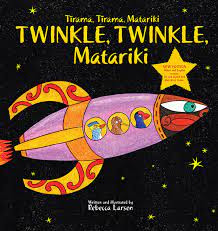
11. Twinkle, Twinkle, Matariki Rebecca Larsen (text and ill.) Imagination Press (2019)
Whistle like the windy sky,
Sprinkle showers passing by.


This charming picture book is both simple and useful. Within an over-arching story format of three native birds (Hoiho, Pukeko and Kiwi) touring outer space in a rocket, it presents a series of simple songs (with a familiar tune) about such things as our food, how it is grown, the seasons, the weather,

and of course the stars that act as markers.

Rub your puku round and round
Food we’ve grown, caught or found.


Bright colourful illustrations by the author match the simple songs, which are provided in both Maori and English. Particularly pleasing is the spaceship which is decorated with Maori motifs, an inspiration for young kiwi astronauts.
A pictorial Glossary ensures that all is explained.
These songs scan well and provide young people with useful vocabulary. The words are provided in both English and Maori. (Translators: Tania Solomon, Justin Kereama).

A bonus CD has the songs sung in both English and Maori by Paul Inia. (Music by Richard Larsen.)

Twinkle, Twinkle, Matariki is the perfect book for a kindergarten or kura kaupapa sing-along in English or Te Reo.


12. The Promise of Puanga: A Story for Matariki  Kirsty Wadsworth,  Munro Te Whata (ill), Scholastic (2019)

‘Hana and Puanga did everything together.’
The Promise of Puanga is a picture book about two friends, and the fun they have together, watching new-born animals in spring, swimming in summer and riding their bikes through the leaves in autumn.
A problem in their area is that winter comes without warning, killing the un-gathered crops. When Hana speaks to Puanga about this problem and the need for a warning about the approach of winter, she gets an astonishing confession.
                                                                                                                 
‘I’m really a star,’ Puanga explained.
She has left her Matariki cousins in order to ‘explore and go on adventures.’
Hana has never seen the stars of Matariki because of the nearby hills and mountains.
Puanga summons Tāwhirimātea, the guardian of the wind, to take her back up into the sky to be a guardian for Hana’s village.
Tāwhirimātea promises that when Hana sees Puanga shining brightly in the sky, she will know it is time for the people to gather their crops. ‘She is our own special sign,’ says Hana. And so it happens.

Munro Te Whata’s splendid illustrations convey the friendship of the two girls in several charming scenes. His portrayal of Tawhirimatea is equally skilful, bringing together the colour of the night sky, the shape of the nearby mountain and the suggestion of clouds as his hair and beard.
The result is a lovely modern story based on traditional Maori elements.

This picture book, The Promise of Puanga, fills an unusual gap. In recent years some half-dozen New Zealand picture books have been published with stories about the cluster of stars Matariki, the rising of which signals the coming of winter and marks the traditional Maori New Year. What none of these books has mentioned is that in some areas along our western coasts, mountainous terrain prevents sighting of these stars (also known as the Pleiades, Mao or Subaru). The Promise of Puanga tells in story form how this astronomical difficulty was solved for the Maori people living in these western areas by the rising of Puanga (also known as Rigel).

There are Teaching Notes for this book at: The Promise of Puanga

A diagram showing Matariki and Puanga is at: https://teara.govt.nz/en/diagram/14080/puanga

In 2019 Scholastic also published an identical Maori language edition, He Purakau Matariki, Te Ki Taurangi a Puanga.


13. Flit the Fantail and the Matariki Map  Kat Quinn (text and ill.)  Scholastic (2021)

This third picture book in the Flit the Fantail series is written and illustrated by Kat Quin (formerly Kat Mereweather).
We’re lost! Flit and Keri cry.
Lured by the moonlight and unable to sleep, Flit has left the safety of his nest and ventured down to the dark forest floor. Flit hopes to capture the moonlight (in order to illuminate his nest). Through the trees, he can see the star cluster known as Matariki.
Tahi, rua, toru, whā, rima, ono, whitu, waru, iwa, he counts.
                                                                                                       
Keri the young kiwi, out foraging, offers to help Flit in his quest. They struggle through the bush and scrub and climb up high but are still unable to reach the moon. The pair realise that they are lost. How can they find their way home?
Ruru the owl sees them huddled together and points to the stars above.
Sometimes those special stars can even guide us home.

Flit spots the cluster of nine stars he saw earlier above his home. He carefully pecks nine holes into a kawakawa leaf in the shape of Matariki. Then the two birds make their way home, using the leaf map to follow the Matariki stars. They reach home just before the sun rises. Flit then has a bright idea. Perhaps he can capture the sun and use it to light his nest at night?

The charming colour illustrations are by the author, Kat Quin.

An identical Maori language edition of Flit the Fantail and the Matariki Map was also published by Scholastic NZ in 2021, as Ko Flit te Tirairaka te Mahere Matariki.


14. Daniel’s Matariki Feast  Linley Wellington & Rebecca Beyer (text)
Christine Ross (ill)  Duck Creek Press. 
English ed (2014); Māori ed (2015) and combined English Māori and Chinese pinyin ed (2021).

On his first day at kindergarten, Daniel is shy.                                              

He is puzzled that they will be having a feast 
because of the stars. 
Then he listens to some of the other children 
telling stories of the Māori New Year.

At home Daniel tells his mother about the feast and she makes a spicy pumpkin soup using her late mother’s recipe. (This is a subtle reminder that Matariki is also a time for remembering those who have died.) Daniel has fun working in the garden with his new friends and afterwards he enjoys his Matariki feast.

Christine Ross’s illustrations really capture the world of small boys and also give a good idea of how to greet the Māori new year.


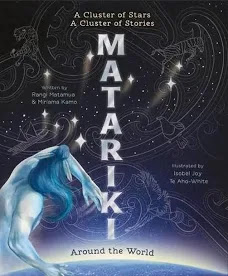
15. Matariki Around the World Rangi Matamua & Miriama Kamo
Isobel Joy Te Aho-White (ill.) 82 pages, hardback, Scholastic (2022)


The subtitle tells it all: A Cluster of Stars, A Cluster of Stories.
Miriama Kamo and Rangi Matamua have gathered stories from around the world that are linked to the distinctive group of stars known to Maori as Matariki. ‘All around the world, the star cluster has different names, different stories, different mahi (jobs), and even different numbers of stars.’ The result is the best book ever written about Matariki.    

The first part of Matariki Around the World describes the Māori traditional creation of the 
world and has handsome double-page descriptions of the Maori gods and the lunar calendar. There are similar double-page retellings of some Māori traditions concerning the attributes of each of the stars Matariki and her eight children (Pōhutukawa, Tipuānuku, Tipuārangi, Waiti, Waitā, Waipunarangi, Ururangi and Hiwa-i-te-rangi). For example Tipuānuku cares for food grown in the earth, and her brightness gives an indication of how kumara crops will fare in the year ahead.
‘Anā! Te paki o Matariki. Behold! The wonders of Matariki.’

The second part of the book offers some retellings of Matariki stories from other cultures around the world. Not only the well-known Pleiades (Greece) and Subaru (Japan) legends are offered but also a range of stories from Africa, Australia, China, India, Scandinavia and North and South America. All are fascinating but the most interesting are the ones from the Pacific, with the similarities and differences sympathetically examined.

The writing style of this book is remarkable. The text is well researched and culturally sensitive but it is also written in a relaxed and witty style. Here the authors are revealing the Viking name for Matariki: ‘So you would think they’d have a pretty tough-guy name for the Matariki cluster, wouldn’t you? Nope. They called it…ahem…Freya’s Hens. Hens? What? Are hens hardy, battle-scarred warriors?’ (We also learn that some Vikings preferred to think of Matariki as a ladybird because of the insect’s seven spots.) Either way, Freya was the goddess who cared for the spirits of dead warriors. ‘So Freya is pretty cool.’
Writing like this makes for enjoyable reading.

Each story is beautifully illustrated by Isobel Joy Te Aho-White.
Best of all, this handsomely designed book has an excellent index and glossary.
It is a picture book which every home should have.

Trevor Agnew  
24 June 2022
The first celebration of Matariki as a New Zealand public holiday.


Thursday, 3 July 2008

The Ginormous Machine Don Coulter

The Ginormous Machine Don Coulter, 2006, Blue Jeans, Waimate NZ, 28 pages, paperback. ISBN 0-473-10874-7

A boy tells in verse the story of the amazing machine his father has built in their garage.
“A machine with an engine gears and a pump
Most of the bits he’d bring home from the dump.”

To the despair of his wife and the irritation of the family pets, his machine nears completion. Although it may wash clothes, scare birds and trim hedges, it has a few teething problems. The day that Dad drives the machine out of the garage proves memorable for several reasons.
Patricia Baker’s colour illustrations are a nice match for the naïve charm of this story.

The Blue Jeans site is at: http://www.bluejeanspublishing.co.nz/index.php

Saturday, 29 March 2008

PIRATES

Pirates John Matthews, Carlton, 2006, 28 pages, hardback, NZ$34.99
ISBN 1-84442-266-6


Pirates Rogues Gallery John Matthews, Carlton, 2007, 26 pages, hardback, NZ$29.99
ISBN 1-84442-592-1

Pirates is not a long book but many of its stiff pages carry fold-outs, mini-books and reprints of letters, posters and playing cards. There is even a concealed map of Jamaica’s Hidden Treasures, giving young readers the feeling of opening their own treasure chest.

John Matthews’s sensible and well-written text winds amongst colourful illustrations of pirate flags, weapons, ships and loot. Along with the Timeline and Nautical Glossary (Abaft to Yardarm), there is a quick summary of fictional pirates, which allows Jack Sparrow and Long John Silver to make their appearance.

The sequel, Pirates Rogue’s Gallery uses the same format to provide brief ,lavishly illustrated accounts of such seagoing rogues as Blackbeard, William Kidd, Jean Bart and Henry Morgan Also present is a woman pirate, Charlotte de Berry.

Both books are well-researched and offer an exciting introduction to both the unromantic reality and the popular fantasy of life as a swashbuckling buccaneer.


This review by Trevor Agnew first appeared in The Press, Christchurch, New Zealand on 30th June 2007.


Jack Lasenby: Still spinning bush yarns

Jack Lasenby
By Trevor Agnew


Are there really man-eating sharks in Lake Waikaremoana. Or is it just a bush camp yarn? Trevor Agnew spoke to that champion bush-camp yarn-spinner, Jack Lasenby.

Harry Returns

Jack Lasenby has done for Waharoa (population 531) what Jane Austen did for Bath. Because of his books, the tiny Waikato town of his birth will always be associated with a golden childhood of summer holidays, boiled lollies, orchard raids, and Uncle Trev’s tall tales of yodelling eels, the Waharoa Women’s Institute Cavalry, bathtub tomato sauce, the dog-scoffing boar pig and the travelling asparagus bed. Many of Lasenby’s stories including The Seddon Street Gang trilogy and Mr Bluenose are set there and his latest novel, The Tears of Harry Wakatipu, begins with the five-year old hero fleeing Waharoa to become a deer-culler.
“I spend a lot of time in my memory there,” says Jack Lasenby. “I’ve always enjoyed trying to push my memory back as far as possible. I find the past fascinating.”

So do others. Recently the Minister of Culture claimed that Jack kissed her mother, former Governor-General Cath Tizard, behind the plantation at Waharoa. Lasenby denies it, “No, Cath’s made it up. What Mum used to make me do was walk Catherine home from our place of a Sunday evening, if she’d come over for tea. Mum never lost an opportunity to teach us manners.” On the other hand, Lasenby knows the value of a good yarn, “Oh God, let’s say I kissed Catherine behind the plantation.” He laughs. “In fact I suspect we were a bit too close, brother and sister virtually, growing up and going through school together. It makes a good yarn though and that’s all that matters, eh?”

A good yarn is Jack Lasenby’s specialty. It is twenty years since he wrote his first novel, The Lake, and took the calculated risk of resigning from his senior lecturer’s position at the Wellington College of Education. While his more serious novels have won acclaim and prizes, it is the knockabout fun of Uncle Trev, Aunt Effie and Harry Wakitipu that children of all ages relish.
Harry Wakatipu, the larcenous packhorse, began “just by being a lazy, greedy slob,” a comic foil for the deer-cullers working in what Lasenby (a former deer-culler himself) insists upon calling the Grim Inscrutable Ureweras. Aware that the kids who began reading about him in the first book, Harry Wakatipu (1993), are growing older, Lasenby has also made Harry older and a little more sinister. Now Harry doesn’t just steal condensed milk; he ferments alcohol from it.
Pitted against Harry (although sometimes singing and dancing with him) is the Grey Ghost, who can walk on water and fires his .303 from the hip. He is based on Ted Rye, the Senior Field Officer, who Lasenby reveres as a master story teller. “He was a very important figure to us in the bush. Barry Crump reckoned he was the father-figure we were all looking for, and I think there was a certain amount of truth in that.”
“Most important, he was a terrific story-teller. And that set the pattern for both Crump and myself, and maybe a number of others too.” No less than six of their group of deer-cullers became published writers.
Lasenby credits his bush story-telling experiences for much of his success. “For years and years, while the old body would take it, I used to go back to the bush each summer, carry a fly-rod, and tramp over all those old tracks and revisit our old camps, most of them disappeared now, of course. And I’d live back there in the time. I’d swear I could hear the voices of those jokers and myself talking to each other. It was like bringing back the past, and I suppose that’s underlayed the writing of the Harry Wakatipu books. It’s not trying to live in the past but to recapture it.”

Note: This interview article by Trevor Agnew was first published on 15th July 2006 in the Press, Christchurch, New Zealand to mark the publication of Jack Lasenby's latest Harry Wakatipu novel.


The Tears of Harry Wakatipu Jack Lasenby, Longacre Press, 2006, 203 pages, paperback, $18.99. ISBN 1-877361-43-7

Friday, 21 March 2008

The Tears of Harry Wakatipu

The Tears of Harry Wakatipu Jack Lasenby, Longacre Press, Dunedin NZ, 2006, 203 pages, paperback, NZ$18.99. ISBN 1-877361-43-7

Are there really man-eating sharks in Lake Waikaremoana. Or is it just a bush camp yarn? Trevor Agnew spoke to that champion bush-camp yarn-spinner, Jack Lasenby.

Harry Returns, by Trevor Agnew

Jack Lasenby has done for Waharoa (population 531) what Jane Austen did for Bath. Because of his books, the tiny Waikato town of his birth will always be associated with a golden childhood of summer holidays, boiled lollies, orchard raids, and Uncle Trev’s tall tales of yodelling eels, the Waharoa Women’s Institute Cavalry, bathtub tomato sauce, the dog-scoffing boar pig and the travelling asparagus bed. Many of Lasenby’s stories including The Seddon Street Gang trilogy and Mr Bluenose are set there and his latest novel, The Tears of Harry Wakatipu, begins with the five-year old hero fleeing Waharoa to become a deer-culler.
“I spend a lot of time in my memory there,” says Jack Lasenby. “I’ve always enjoyed trying to push my memory back as far as possible. I find the past fascinating.”

So do others. Recently the Minister of Culture claimed that Jack kissed her mother, former Governor-General Cath Tizard, behind the plantation at Waharoa. Lasenby denies it, “No, Cath’s made it up. What Mum used to make me do was walk Catherine home from our place of a Sunday evening, if she’d come over for tea. Mum never lost an opportunity to teach us manners.” On the other hand, Lasenby knows the value of a good yarn, “Oh God, let’s say I kissed Catherine behind the plantation.” He laughs. “In fact I suspect we were a bit too close, brother and sister virtually, growing up and going through school together. It makes a good yarn though and that’s all that matters, eh?”

A good yarn is Jack Lasenby’s specialty. It is twenty years since he wrote his first novel, The Lake, and took the calculated risk of resigning from his senior lecturer’s position at the Wellington College of Education. While his more serious novels have won acclaim and prizes, it is the knockabout fun of Uncle Trev, Aunt Effie and Harry Wakitipu that children of all ages relish.
Harry Wakatipu, the larcenous packhorse, began “just by being a lazy, greedy slob,” a comic foil for the deer-cullers working in what Lasenby (a former deer-culler himself) insists upon calling the Grim Inscrutable Ureweras. Aware that the kids who began reading about him in the first book, Harry Wakatipu (1993), are growing older, Lasenby has also made Harry older and a little more sinister. Now Harry doesn’t just steal condensed milk; he ferments alcohol from it.
Pitted against Harry (although sometimes singing and dancing with him) is the Grey Ghost, who can walk on water and fires his .303 from the hip. He is based on Ted Rye, the Senior Field Officer, who Lasenby reveres as a master story teller. “He was a very important figure to us in the bush. Barry Crump reckoned he was the father-figure we were all looking for, and I think there was a certain amount of truth in that.”
“Most important, he was a terrific story-teller. And that set the pattern for both Crump and myself, and maybe a number of others too.” No less than six of their group of deer-cullers became published writers.
Lasenby credits his bush story-telling experiences for much of his success. “For years and years, while the old body would take it, I used to go back to the bush each summer, carry a fly-rod, and tramp over all those old tracks and revisit our old camps, most of them disappeared now, of course. And I’d live back there in the time. I’d swear I could hear the voices of those jokers and myself talking to each other. It was like bringing back the past, and I suppose that’s underlayed the writing of the Harry Wakatipu books. It’s not trying to live in the past but to recapture it.”

Trevor Agnew

This review appeared in The Press, Christchurch, New Zealand, on 15th July 2006.

The Reed Samoan Picture Dictionary

The Reed Samoan Picture Dictionary ill Dale Tutill, Reed, 75 pages, paperback, NZ$29.99
ISBN 1-86948-107-0

This large format well-illustrated dictionary follows the popular format pioneered by The Reed Maori Picture Dictionary (2002). It offers more than a thousand commonly-used Samoan words, each accompanied by a pictorial explanation: Push: tulei; pushchair: nofoa tulei. The arrangement is by the alphabetical order of the English equivalent, which makes this dictionary particularly useful for English-speaking readers seeking Samoan equivalents. Some words also have sentences to make their meaning clear: Grow: toto . We grow watercress at school. E matou te toto ina kapisis vai I le a’oga.

Also listed are terms for relatives (parents:matua), everyday speech (thank you: fa’afetai), days, seasons, months, colours and parts of the body (knee:tuli). Ideal for classroom or library use, this dictionary will also be helpful in many homes. The clear layout and design is complemented by Dale Tutill’s helpful illustrations

Trevor Agnew


This review appeared in The Press, Christchurch, on 11th November 2006.

Barnaby Bennett

Barnaby Bennett Hannah Rainforth, ill. Ali Teo, Huia, Wellington NZ, 2006, 30 pages, paperback, NZ$16.99
1 86969 232 2

“I’m Barnaby Bennett. I only wear red.” Young Barnaby’s enthusiasm for red clothes (including his grandfather’s red underpants) is not shared by his family, since he won’t let them be washed. He even wears his red clothes to bed. His whanau offer alternative colours in vain, “‘Boy,’ said his Dad, ‘Quit this to-do. Why don’t you put on some nice navy blue?’” Each double-page spread becomes funnier as Barnaby becomes scruffier, until his Nanny arrives with a solution that Barnaby can’t resist. Young readers will enjoy spotting the flaw in Nanny’s brilliant idea. Hannah Rainforth’s comic verse narration evokes Dr Seuss with its marvellous rhymes, while Ali Teo’s collage illustrations are a comic delight in their own right.


Trevor Agnew

This review appeared in The Press, Christchurch, on 27 January 2007.

Davy's Ducks

Davy’s Ducks Dorothy Butler, Lyn Kriegler, Reed, 24 pages, pb, $19.99
ISBN 1-86948-403-7

Davy’s Ducks is a charming story, set in Edwardian Waihi, just as the first tar-sealed roads were reaching into the countryside. Davy’s task is to care for the family’s Muscovy ducks and keep them away from the farmhouse but he is captivated by the workmen and their machinery, especially the massive steamroller. One night he discovers that the ducks have strayed onto a freshly tarred section of road and are all stuck! The family wrap the ducks in bits of cloth to keep them warm overnight. Lanterns keep them from being run over. Next day, in the warm morning sun, they free the ducks and clean them. Davy is surprised to find that his problem of straying ducks has been solved. Dorothy Butler’s richly detailed retelling of a favourite family story is matched by Lyn Kriegler’s handsome colour illustrations.

Trevor Agnew

This review appeared in The Press, Christchurch, on 27 January 2007.

Carpet of Dreams

Carpet of Dreams Tessa Duder, ill. Mark Wilson, 34 pages, Angus & Robertson [HarperCollins], hardback $26.99 ISBN 0-207-19999-X

Carpet of Dreams is Tessa Duder’s first picture book. Sara is fascinated by an old carpet at her grandmother’s home. Each night she dreams of one of the magnificent animals woven into it and the young dark-haired girl who wove the carpet. The dolphin, camel, donkey and lion each tell Sara their story by night, and during the day her grandmother answers her questions although, after the elephant dream, she is a little embarrassed about her ivory piano keys. “‘Well,’ said Sara, ‘We could just thank the elephant…and play our duet.’” At the end of the story Sara makes a charming discovery about her grandmother, which many readers will already have suspected. Mark Wilson’s richly coloured double-page paintings capture the excitement and exotic appeal of this wonderful story.

Trevor Agnew

This review appeared in The Press, Christchurch, on 27 January 2007.

Big Farm Machines

Big Farm Machines, All Sorts of Trucks Pauline Cartwright, Reed, 2006, 24 pages, paperback, NZ$19.99 ISBN 1-86948-108-9; ISBN 1-86948-109-7

With Christmas approaching, books make ideal presents. At the moment there is a particularly fine range of New Zealand children’s picture books, for all ages.
Children who prefer non-fiction are not always well served but Pauline Cartwright’s Big Farm Machines and All About Trucks are welcome re-issues of large format colour photograph books which have proved a hit with kiwi kids, not all of them boys.

Tim Hawkins’ photos show inquisitive children at the Alexandra Blossom Festival’s truck parade learning all about B-trains, tractor units and bug deflectors. Fact boxes, captions and a lucid narrative provide plenty of information. Big Farm Machines has the same format but a wider range of equipment – from helicopters to sheep-dipping machinery. Again the large colour photos provide clear detail, often following processes, such as milking cows or hay baling, to show just how the machines work.

Trevor Agnew

This review appeared in The Press, Christchurch, on 27 January 2007.

Zachary Quack Minimonster

Zachary Quack Minimonster Lynley Dodd, Puffin, 2006, 32 pages, paperback, NZ$14.95
ISBN 0-141-50039-5


With Christmas approaching, books make ideal presents. At the moment there is a particularly fine range of New Zealand children’s picture books, for all ages. Lynley Dodd’s name is always a guarantee of lively verbal fun matched with delightful pictures. Zachary Quack Minimonster follows the impetuous duckling in pursuit of a dragonfly. When Zachary becomes entangled in leaves, petunia flowers and paint, he is transformed into an alarming monster. With its witty verses, this is a wonderful book to share. Young readers will also enjoy studying the pictures and spotting Hairy Maclary and his friends among those fleeing from the monster.

Trevor Agnew

This review appeared in The Press, Christchurch, on 27 January 2007

Miranda's Alphabet

Miranda’s Alphabet: Learning Letters with Pictures Miranda Harcourt & Stuart McKenzie, ill. Paul Densem, South Coast Press (82 View Road, Houghton Bay, Wellington, New Zealand), 2006, 58 pages, paperback, $19.95

This alphabet book is based on the interesting idea of matching the shape of each letter to a picture of an object whose name uses the sound of that letter. Thus capital A is an ant-hill, while small a is an apple. Paul Densem has produced bold and attractive cartoons which are integrated with colour photographs of Miranda Harcourt and two children interacting with each letter, capital and lower-case, across a double-page spread.


The two Ms are typical: “Magnificent Mountains!” marvels Miranda. “Mine are mounds,” murmurs Thomasin. Where a letter has more than one sound, both have been included, with circular cats for C and giant goldfish for G. What child will be able to resist the idea that “Big B looks like a bottom” when they see the cartoon of a baboon fitted neatly into the B?

Miranda’s Alphabet is easy to handle, with a clean, uncluttered design. Since its pages are light card, rather than paper, they will be able to cope with the constant handling they deserve. The alphabet is also available, separately, as a set of wall-cards at $24.95.

Trevor Agnew


The Unpublished Spike Milligan Box 18

The Unpublished Spike Milligan: BOX 18 edited by Norma Farmes, Fourth Estate, London [NZ rep: HarperCollins], 2006, 254 pages, paperback, NZ$36.99.
ISBN 0-00-724195-X

The first surprise in this book is how well organised Spike Milligan was, an impression confirmed by his long-time manager and friend, Norma Farnes. In the office “he was the most focussed person I have ever met: disciplined, methodical and meticulous about his filing system.” Spike’s office held shelves of box files where his work, scripts, interests and enthusiasms were all recorded. Box 18 was subtitled simply “IDEAS” and it was here that first drafts of poems, scripts, sketches speeches and stories were filed for later development. Badjelly the Witch began in Box 18 and so did It Ends With Magic.
The documents printed here include radio and TV sketches, children’s stories, poems and even a Goon Show script, The Tree Maniac. Some are in Spike’s own writing with typed transcripts. The flavour is pure Milligan and the addition of diary pages, letters and photographs capture his wide range from poignant to hilarious. There is no suggestion of a scraped barrel here and this anthology makes a fine companion piece to the various biographies of Milligan.

Trevor Agnew


This review first appeared in The Press, Christchurch NZ, on 6th January 2007.

Canterbury Picture Books

The Little Penguin Who Wouldn’t Eat His Dinner Jane Buxton, ill. Philip Webb, Reed, 25 pages, paperback, NZ$14.99. ISBN 1-86948-596-3

The Penguin Who Wanted to Fly Ben Brown, ill. Helen Taylor, Reed, 32 pages, paperback, NZ$16.99. ISBN 1-86948-406-1

No Ordinary Flowergirl Marlene J. Bennetts, ill. Trish Bowles, Reed, 28 pages, paperback, NZ $16.99. ISBN 1-86948-432-0.

Kiwi Kicks for Goal, Kiwi and the New Player John Lockyer, ill. Bob Darroch, Hodder Moa/Hachette, 32 pages, paperback, NZ$17.99 each.
ISBN 1-86971-079-7, ISBN 1-86971-080-0

Canterbury Picture Books

Later generations will look back on the early years of this century as a golden age of children’s books, especially picture books. Interestingly each of these five New Zealand picture books has a Canterbury artist or author. Each of them is a book to be proud of.

In 1993, Ben Brown and Helen Taylor of Lyttelton created The Penguin Who Wanted to Fly, first as a comic-style picture book and then as a popular play. Now with its text lightly polished and handsome new realistic illustrations, the plucky little Adelie penguin with high ambitions, is presented to a new generation. “I’ll try and I’ll fly,” he says as he climbs progressively higher up the rocks and icebergs. “Good grief, what a drop!” While he never succeeds in flying, the penguin makes an amazing discovery, which will bring joy to young readers. Helen Taylor’s watercolours are a superb match to her husband’s amusing text, making this book an exemplar of design and typography.

John Lockyer’s Kiwi is a keen junior football player, who learns a lot as he prepares for play with the black-clad Pipis team (which includes Weta, Koura and Kiore). In Kiwi Kicks for Goal, he is able to overcome his own nervousness about kicking when he has to help Pukeko kick. In Kiwi and the New Player, Kiwi has to deal with his own prejudices when Hawk joins the team. “He had heard about hawks too…They were fierce and impatient…Hawks were scary.” Kiwi soon learns that Hawk has great tackling skills but is shy. Bob Darroch of Waimate has created the best pictures of his illustrating career for these two lively books, which will be treasured for their simple stories, positive messages and remarkable cartoon illustrations of animal football encounters.

“Fish is boring,” said Paru, “I want something different.” The title outlines the basic story of The Little Penguin Who Wouldn’t Eat His Dinner. Young readers will soon see interesting parallels as Paru, the yellow-eyed penguin, decides he doesn’t like fish and begins an amusing survey of other possibilities. Inspired by the fantails and pigeons, he tries insects and berries. “But, oh no! They tasted terrible.” Jane Buxton of Rangiora has created a witty text, nicely matched by Philip Webb’s, handsome colour illustrations, which shows how Paru learns which food is best for him, and saves his father as well.

Christchurch writer, Marlene J. Bennetts has captured a grim moment in a young girl’s life – the beautiful apricot-coloured, net and lace dress, which Kyra was to wear at Aunt Rene’s wedding, has been left at home – and from it has created an inspiring and cheerful story, No Ordinary Flowergirl. Since Kyra lives in Brisbane, this elegant picture book also provides a simple, unforced introduction to some Maori customs and traditions. Trish Bowles’ skilful illustrations capture all the excitement of the wedding at the marae, and the pleasure Kyra finds in her unexpected new role.

These books are a useful reminder that it’s not too early to buy good Christmas presents.

Trevor Agnew


This review first appeared in The Press, Christchurch on 18th November 2006.

Kiwi Bites


I’m Telling on You Sandy McKay, Puffin (Kiwi Bites), 95 pages, paperback, NZ $14.95.
ISBN 0-14-331844-6
Brenda’s Planetary Holiday Tina Shaw, Puffin (Kiwi Bites), 96 pages, paperback, NZ$14.95
ISBN0-14-331838-X
Ocean Without End Kelly Gardiner, HarperCollins, 174 pages, paperback, NZ$16.99 ISBN 1-86950-585-9
The Book of Changing Things and other Oddibosities Odo Hirsch, Allen & Unwin, 197 pages, hardback, NZ$29.99. ISBN 1-74114-355-1

The Kiwi Bites series provides a lively bridge, carrying young readers from stories to novels. Sandy McKay has created a sympathetic narrator for I’m Telling on You. “Ages ago I didn’t have many friends. Well, actually, none. But it was my own fault…” Timothy, the class tell-tale, burdened with his mother’s expectations (clarinet and floral art lessons), yearns for friends and a chance to try skateboarding. He succeeds in both areas but faces a moral crisis when he puts a skateboard through the classroom window. This is a witty and warm-hearted tale of friendship, truth and consequences.


Tina Shaw takes student home-stay exchanges to the next logical step in Brenda’s Planetary Holiday. Brenda succeeds in swapping places for a week with Zink from the Planet of the Beezee Birds. Zink copes surprisingly well with Earth cats and bathtubs, while Brenda is entranced by a diet of nice biscuits and white jellies. Some gentle satire will appeal to young readers: Zink’s sister despises his posters of the tall Snooks, who “make ear-bashing sounds. Zink thinks they are cool. He is so immature!”

Lily Swann is only 12 when she is captured by pirates, but her courage and navigation skills soon help her to rise from slavery to a valued member of the pirate crew. Kelly Gardiner doesn’t avoid the violence and death of the pirate world – Lily has to help the cook treat the wounded and dying in battle – but she has also created a fast-paced, swashbuckling story. Surrounded by larger than life characters like Captain Diabalo, the Blackbeard of the Barbary Coast, and Hussein Reis, the renegade Irish Captain, Lily manages to achieve friendships and begin her quest for her missing father. Is he a pirate or a castaway? Ocean Without End is the first of what promises to be a very lively series.

“Straight into the monster’s mouth they went.” Odo Hirsch, creator of the Hazel Green series, also knows how to keep a good fantasy rolling, even if he’s a little hard on his characters. When Nathan’s school principal makes a boring speech, Nathan daydreams and soon he is in a strange landscape with Pogue the Squirrel and the Count Marvel Genarvel von Hubble von Jubble von Mirt “but everyone calls me Marvy”. In the yellow hills, where the wind smells of roast beef and trifle, the three encounter oddities, transformations, wordplay and strange, talking creatures. While some may find the constant changes tiresome, bright readers who appreciate the slightly sinister worlds of Lewis Carroll will delight in The Book of Changing Things, especially its very appropriate ending.
Trevor Agnew


This review first appeared in The Press, Christchurch, New Zealand on 22 April 2006.

When Mum Went Funny

WHEN MUM WENT FUNNY Jack Lasenby, Longacre, Dunedin NZ, 153 pages, paperback, NZ$16.99.
ISBN 1-877361-53-4

When Mum Went Funny is a warm and witty re-creation of rural life in wartime New Zealand, seen through the eyes of a young family. The youthful narrator thinks his Mum went crazy during the war but readers will quickly see that Mrs Costall is just coping with the problems of raising a family and running a farm single-handed while her husband is fighting overseas.

Her four children may be poor but they have a rich fantasy life. They ride Old Pomp to school at Waharoa and pretend he’s a Lancaster bomber. ‘Kate was the pilot, and the rest of us squabbled over who was going to be the air gunner in the rear turret.’
There are lively accounts of such events as putting the car up on blocks, milking the house-cow and driving the sheep to Waharoa. Mum often talks to God (“You’d think a poor old body on her own wouldn’t have to slave out in her garden from daylight to dark to put food on the table for four great overgrown children.”), spins outrageous yarns and threatens to sell her children to the visiting circus for lion-tucker. Mum’s threats always turn out to be jokes on her family. Tired of cooking, she shows them food pills to replace meals. It is only after a long debate that the children realise they are being offered peppermints.
Jack Lasenby’s humorous invention never flags, making this the best account ever of a mother who played barefoot for the All Blacks.

Trevor Agnew

Old Bones


OLD BONES Bill Nagelkerke

OLD BONES 
 Bill Nagelkerke  
Scholastic (2006)
219 pages, paperback 
ISBN 1-86943-725-X


Old Bones is a completely different and very impressive fantasy novel, set in Christchurch. It uses a skilful double narrative to bring together a present-day boy, Jamie Clarke, reluctantly moving to a riverside suburb and Charlie Patterson, a seventeen year old farm boy who drowned in the Avon eighty years ago. Their meeting place is the former farm-house, Cloverly, where Charlie’s spirit settles in God’s Eye, the witch’s-hat tower above his old bedroom which later becomes Jamie’s room.

Jamie hates rivers, having seen the family farm destroyed by three consecutive floods. He also resents his father’s new (and pregnant) partner Sue. Even though he draws up a huge list of grievances, Jamie is actually an agreeable and positive boy and he soon becomes intrigued by Cloverly’s unusual history and by Marion, an old lady who lives next door. He even finds himself persuaded by young Ros to come rowing on the river with her.

Charlie’s spirit, meanwhile, has been active and the reader gradually realises that this is a love story rather than a ghost story. Jamie and Ros find themselves recruited to help Charlie in a way neither of them had expected, making an exciting boat trip during a dangerous storm. “Water raced from the tunnel mouths. It would meet the boat head on and swing it round in a vortex. They’d overturn. Be swallowed by the water. Drown.” The river, seen both as a threat and as a source of life, is a recurring theme in this story. The ending skilfully allows readers to draw their own conclusions and assemble their own version of events.

Already well established as a writer for young people, Christchurch author Bill Nagelkerke has excelled himself here.

Trevor Agnew

Chute Through

CHUTE THROUGH Janice Marriott, Mallinson Rendel, Wellington NZ, 186 pages, paperback, NZ$17.
ISBN 0-9582626-3-2


Janice Marriott is having a brilliant year. Her dramatic novel Thor’s Tale is now followed by a comic science fiction romp, Chute Through, set 70 years in the future.
Chute Through is Arlo’s account of the worst month in his teenage life. Living on a city-sized slum-raft, the bored but imaginative Arlo dodges homework, spars with his sister, Jazman, tries contacting aliens and creates inventions that generate chaos. (Invention 134, snails that consume detergent as they slide up the window, is typical.) The family watch Celebrity News and eat Lush Mush, Krill Krispees and Kelp Krackle. Arlo’s virtual lessons are sponsored by “Glittergum, the gooey chewy snack that lasts forever. Buy a pack for life. Rent it out to friends.”
Slapstick disasters abound as Arlo’s inventions catch the interest of a larcenous astronaut clothing designer, Luke Laster, creator of the motto, “The more pockets you have, the more important you are.” Tormented by the family’s talking fridge and over-efficient, under-imaginative household robot, Arlo dreams of escape but this cheerfully chaotic novel ends in a surprise for him and everyone else.

Trevor Agnew

Genesis

GENESIS Bernard Beckett, Longacre, 144 pages, paperback NZ$18.99. ISBN 1-877361-52-6

With Genesis Bernard Beckett has excelled himself. In a grim future of biological war and plague, New Zealand has sealed its borders and armed sentries wipe out all approaching refugees to protect their ideal society. This novel is set decades later as Anaximander, a young history student, faces her final Academy entrance exam, on the life of a sentry who controversially broke his trust. Three Examiners question her for five hours about her topic, ‘The life and times of Adam Forde, 2058 - 2077’. It is a tribute to Beckett’s skill as a writer that while the story is told almost entirely in a question-and-answer format, it is always tense and exciting.


It soon becomes clear that Adam’s involvement with the education process of robots raises all sorts of issues about morality, justice, artificial intelligence, thought experiments and what it means to be human. It is also clear that Adam (“the match that lit the fire”) was responsible for some radical change in society but only hints are given. Then just as the Examiners reveal a hidden truth to Anaximander, readers realise that they have also been misled and are taking part in a thought experiment. This powerful and moving novel will open many doors for able readers.

Trevor Agnew


This review was first published in The Press, Christchurch, New Zealand on 17th March 2007.