Jack Lasenby
Transcript of interview,
Tue 23
May 2006, by Trevor Agnew
[Arranged by Longacre Press, at time of publication of The
Tears of Harry Wakatipu]
Jack Lasenby:
JL
Trevor Agnew:
TA
Phone call,
11 am
23-5-2006:
JL: Jack Lasenby.
TA: Hello, it’s Trevor Agnew here, in
Christchurch, Jack.
JL: Oh, How are you Trevor?
TA: Thank you very much for agreeing to let me talk to you
on the phone
 |
| The Author as seen by Bob Kerr |
JL: Oh, that’s okay. Thanks for being interested in doing
anything.
TA: Oh, no, I’m fascinated by your books. We’re hoping to do
500 words in The Press, and there may, or may not, be other things I want to do
out of it, so can I ask you all sorts of questions?
JL: Yes, of course, anything you like.
TA: We’re kicking off the fourth volume of Harry Wakatipu,
but there’s lots of other things I want to ask you about. I don’t know where to
start. Can we start in Waharoa?
With your birth in Waharoa?
JL: Yeah.
TA: I’m fascinated that it’s a place you’ve made into a
literary, um, I don’t know, it’s become a place like Jane Austen’s
Bath.
JL: Well, I never intended it, Trevor. It’s just like Topsy,
it’s sort of grown that way.
TA: Oh yes.
JL: I don’t know if it’s a consequence of that or the other
way round, I spend a lot of time in my memory there. But then I suppose I do
that anyway, with places where I’ve spent time. I seem to revisit them a lot.
In fact, I love…I’ve always enjoyed trying to push my memory back as far as
possible, and bring back those past events. Partly out of sheer cussedness,
because people tend to say you mustn’t bother about the past and all the rest
of it. But I find the past fascinating.
TA: I think you’re the one who has written the best
children’s books about the past and the future of
New Zealand. You don’t write about
the present much?
JL: No, no, and that was a bit of a surprise to me. A few
years ago I thought that and I thought that I should be writing about things in
the present as well, and then I thought, no, why the hell should I? There are
plenty of people doing that. Then I tried to rationalise it and I decided most
of the best books are not written about the immediate present. I’m not just
thinking of kids’ book but most books are written with a sort of retrospective
idea. Dickens, for example. So much of what was appalling in his novels wasn’t
happening in his time. He used the distance to advantage, it seems to me.
 |
| Bob Kerr's cover for Harry Wakatipu |
I know there’s lots of present and futuristic writing as
well. But as I said
, that’s probably my way of rationalising it. Also I’m just
so busy on what I’ve got, and I have been for the past umpteen years.
TA: Yeah, I can’t believe how much you’ve written. I’ve been
working, putting some of it on to a database in
Australia [The Source] and it’s
huge
JL: Yeah, I’m a bit surprised myself. It just keeps coming
out. Although I’m getting pretty long in the tooth now – I’m seventy-five - I’ve
still got umpteen books under way at various stages, finished and waiting and
so on.
TA: I’m pleased to hear that.
In 1986, I was at
Wellington Teachers’
College and you spoke to Gwen Gawith’s Trained
Teacher-Librarians Group.
JL: Oh, were you on that?
TA: I was in that first group, yes.
JL: Was that the one that Margaret Mahy was at as well?
TA: Margaret Mahy came and spoke to us, yes.
JL: Aaah. Funny, somebody else, another librarian, was just
talking about that. Goodness, that was years ago.
TA: You came and spoke to us. You had written The Lake at
that stage and it hadn’t yet been published. It was obviously a key moment in
your life.
JL: It was, very much. It was because of that book [The Lake,
1987] that I took the decision to give up College and write fulltime. And I did
so. It was a crazy thing to do. I gave up a Senior Lectureship and a good
salary at the College and just crossed my fingers and hoped that Muldoon’s
superannuation would be there when I got to it, and it was, luckily.
TA: That book reads very well. It hasn’t aged.
JL: Goodness, I haven’t looked at it for years and years. I
don’t know if I’ve looked at it since that time. It comes to mind every now and
again when somebody mentions it. You know, the odd letter from a kid. They still
write occasionally and say when are you going to write a sequel to The Lake?
I think, God, there isn’t time for sequels.
I did think of two or three sequels, the plots for them but
I was busy with other stuff.
But it was important to me, very important in getting me
going, and also in settling a few bits.
The
girl, Ruth, the protagonist in the book itself partly arose from my direct
experience back in my teaching days, and of course my direct experience of the
bush. So it all came together
TA: I was impressed by a minor aspect of The Lake – I was
impressed by the major aspects as well - but the minor one I thought was
fascinating was the New Zealandness of it. For Ruth, it is
Maui
who steals the secret of fire, not Prometheus. She’s got the Maori myths and
she’s got her father’s copy of The Plants of New Zealand, and she whispers the
secret names of the plants in the bush.
JL: You bring it back now. The naming was very important it
seemed to me - for her.
The thing was
that a dear old friend in
Auckland,
Minna Wolfgram, had given me a copy of Lang and Blackwell [The Plants of New
Zealand] and I carried it in the bush myself, in the way that Ruth did, to
teach myself the names of the trees.
In
that way, I found myself much more comfortable once I could put names to them.
A very common phenomenon, of course. I love that book. In fact, I’ve still got
a copy of it on hand, on my desk where I write, just to check things and
verify.
A beautiful book. Long outdated
of course. It’s still got a particular quality to it.
TA: I would agree.
JL: But the New Zealandness, I don’t know.
I didn’t ever write consciously o
f
New Zealand;
still don’t. I’m just writing out of experience, of course, and
New Zealand is
what I am and where I am, so it’s there.
TA: Good.
JL: And I just read one of Vince O’Sullivan’s short stories,
he gave me the other day, his new volume of short stories. And there’s a
reference to a woman with a spectacular bust. And she did the Allen Curnow
poetry-writing course at
Auckland
University, it says in
this story - I don’t know whether Curnow actually ran such a course - where she
was called “spectacular bosom.” A throw-off at Curnow’s marvellous “spectacular
blossom” poem, of course. I’ve mentioned it to several people in the last
couple of days and they all say, oh, that’s a bit arcane, that’s a bit…
Arcane – that’s the word one person used. Only a few people
will pick that up. I said, but God, Joyce described the “pieways and byways of
Dublin” And yet he’s been
read by thousands in
New
Zealand. Why shouldn’t we take things for
granted the same way:
New
Zealand things?
TA: Yes, I’m reading The Tears of Harry Wakatipu and I came
across this part where the narrator goes up to Galatea Station so early that “there
was no movement at the station”. I don’t know if your
New Zealand
readers are going to pick that up but the Australians are.
JL: That’s directly from whatsisname’s poem, of course, “for
the word had passed around that the colt from Old Regret had got away.” [Banjo
Paterson, The Man from
Snowy
River] I love that sort
of thing.
TA: I know your books are full of it, both overt and
concealed.
JL: Well, I enjoy dropping allusions in. I don’t strive to
make them but from that very first book, The
Lake...
In fact I remember arguing with Anne French at the Oxford University Press about
one or two of my too obvious allusions.
But
she didn’t notice things, such as towards the end of it – not The Lake but The
Mangrove Summer -there’s a bit from Yeats’s The Second Coming “some rough beast
slouching across the river” – the wind – and Anne didn’t pick it up and I was
pleased and I sort of hugged it to myself because I am a big reader and an avid
reader and, I hope, a very good reader. And all that past literature is
enormously important to me.
And I don’t think
most writers-teachers-parents do the job well enough of passing it on – that
cultural thing.
TA: That’s almost the theme of your trilogy [quartet]
Because We are the Travellers and The Shaman and the Droll and so on – saving
the books?
JL: Yes, very much so.
TA: Actually it’s rather nice there because you find chunks
of books and you’re not told what they are, and you have to work out that they’re
Great Expectations or Kim or whatever.
JL: That’s right. Great Expectations is another of those
books that I re-read every year and it just has been a powerful influence on me.
Ever since I first saw it, actually as a film, that old black and white BBC film.
And I used to read it - when I became a teacher - I used to read the whole
thing to my kids at school and then get a local cinema to put the film on and
take them to see it.
TA: Magwitch.
JL: Yeah, wonderful Magwitch and Miss Havisham. And Oh, all
the characters
Brilliant stuff. One of the great kid’s books, it seems to
me.
TA: John Mills and the young Alec Guiness
JL: Yes, that’s the one. It seems to me wrong to see such
books as adult books only. Theyr’e very much children’s books, in a certain
sense too.

TA: I was looking at The Mangrove Summer and I found
something that turned up, that also occurred in one of The Seddon Street Gang
trilogy, where somebody dies and the children don’t sort of know how to take it
in.
JL: That’s right. Jimmy.
TA: Yes.
It was sort
of tragic in The Mangrove Summer and it’s sort of slightly minor, almost, in… I
can’t remember which of the Seddon Street Gang books it is.
[
A hopelessly confused
muddle here, with both of us deaf and not connecting.
TA was thinking of the
boy who died of polio in The Waterfall.
JL was thinking of
Jimmy dying in The Mangrove Summer, and of Denny’s father dying in Dead Man’s
Head. ]
JL: It was the boy’s – oh, what was his name now?
TA: Yes, the boy got polio and died.
JL: His father died
TA: Oh yes, the father died. That’s right, I remember the
father dying. I was thinking of the wee boy who died of polio and they forgot
him by the next summer.
JL: Sorry what was that, Trevor?
TA: There’s a wee boy dies of polio and they forget him by
the next summer
JL: In the Mangrove Summer. Yes, Jimmy the little boy died, he
was drowned in the mangroves
TA: That death in the
Seddon Street ones is well done.
JL: Yes.
TA: Actually, I was very struck…It’s totally irrelevant, but
I think you’ve got the only decent description of a really good hiding going on,
in children’s literature in
New
Zealand
JL Of a really good
what,
sorry?
TA: Of a good hiding, a good belting.
JL: Yes, well, I was interested… I think Paula edited it,
that series, Paula Bock… great editor. Just as she’s a good writer, she’s a
wonderful editor. She made me take out one hiding that one of the kids got, that
Bob - the sort-of leader boy - got when they got home after the Battle of Pook
Island. She said, oh look, you can’t have Bob get a hiding; he’s just led a
whole successful battle, and suddenly he’s reduced by it.
And I took it out - it was only a
sentence or two, but I thought I was being consistent to the times, that’s all,
and I gave in to Paula’s emotion.
But that hiding in the first one
of that trilogy, Dead Man’s Head, yes, that was very significant. It happened
in my own life. A dear, dearly-loved aunt gave me an unfair hiding. And there
it popped itself up in a book, years later.
TA: Well, it’s very powerful and of course it doesn’t occur
in most children’s literature. It’s interesting, because looking back in my own
life and in all of
New
Zealand’s history, it’s been a great
tradition, I guess.
JL: I think we’ve become too self-conscious about that sort
of thing; politically correct rather than self-conscious.
Today’s kids, we don’t think we should scare
them with it. It happened; therefore we have to refer to it, however obliquely
or directly.
TA: Yes, indeed.
JL: The same thing, Jimmy’s death - I suppose I can admit it
now - is in a sense the death of a brother, who died before the rest of us were
born.
Not in that way at all. But I realise
now, perhaps I was working something out about his death in The Mangrove Summer
that I wasn’t aware of at the time.
TA: Right, it’s got the mood of it, you know.
JL: And most of such events in the books come from either direct
or observed experience at some level, but I find a tremendous lot of it is directly
experienced stuff and, well, you know the process, that sort of transmogrification
of it on to a fictional character
TA: Indeed and beautifully done.
JL: And often, often there’s an unconscious level. You realise
later just what it is you’ve been up to.
TA: I’m in awe of something which doesn’t get mentioned a
lot, which is your Uncle Trev stories.
I
had to summarise them all for the Australians [The Source]. I think there’s 116
or something. They’re fabulous.
JL: Good. Delighted to hear it.
TA: The thing that puzzled me, in my summary, is that I
remembered somewhere that you’d written that the narrator is a girl. I think
somewhere she is asking her mother about inheriting her jewels or something.
And so in all my summaries I wrote that she was a girl. And I thought, later
on, now I have been looking at the pictures in the School Journal and it’s a
boy. So I’m not quite sure where I am.
JL: That’s right. It was done without my approval in the
School Journal. In fact I was very annoyed but I hadn’t stipulated it as a
condition of publication. In my bloody egotism I didn’t think of it.
JL: The thing was I didn’t want to identify it as either
girl or boy.
TA: That’s true. It’s very neutral.
JL: At that time there were the beginnings of that thing
that ‘girls can do anything and we must ignore the boys’, a stupid precept that
many teachers and parents followed. I think it actually underlies one of the
minor reasons for the increased youth suicide rate. A lot of boys simply got
ignored by everybody. I’d say a minor factor but it’s still something I feel
partly responsible for, having been at teachers’ college and a teacher, and
going around schools. I found myself tending to overlook the boys wanting to
ask questions, and nodding to a girl instead. And I thought this is absolutely
wrong. So, when I wrote the Uncle Trev stories, I tried not to identify the boy
or girl things, not to identify the protagonist sexually. I didn’t see any need
for it
TA: The trap is when you’re summarising; you’ve got to write
‘he’ or ‘she’. I wrote ‘she’ all the way through.
JL: That’s right. I’ve done that several times, or else
suppressed the sex of the child.
In a recent book, Mr Bluenose, I actually had a girl in mind
but Paula launched that book and she described the protagonist as a boy. In
fact she gave him the name Jack because the girl is never named. I thought I
made it fairly clear towards the end that it was a girl. But several people
have said to me oh no I read it as a boy. I’ve said that’s pure assumption on
your part; the author’s a man, so therefore it must be a boy.
TA: I’m pretty sure I read it as a girl.
JL: You did.
TA: Again, my grandchildren have taken off with my copy…
JL: I’m delighted to hear that somebody is reading it as a
girl. Because towards the end of it she’s sitting on the handlebar of her
father’s bike, getting a double home and she asks him about when he’s going to
give her her mother’s amber beads to wear. And he tells her, well, they’re
handed down from mother to daughter at the age of 18.
In fact her mother, in my mind - in the sort of background
to a book that the audience, the reader, doesn’t need to know about - her
mother has died fairly recently. And in fact she’s still very disturbed by it,
and this is why that group of men are keeping an eye on her, for her welfare
TA: That’s good. I didn’t pick that up. I can see it, now
that you say it.
JL: There’s no need for the reader to know all that. That’s
the author’s. I presume that’s something of why we write the books that we do,
Trevor. I don’t know.
TA: I can see what you’re saying and that’s good. In fact, there’s
an Uncle Trev story the same way, isn’t there? Where the boy - I always think
of it as a girl – finds Uncle Trev working on her father’s grave, cutting the
grass or something.
JL: That’s right. Like most of these things that you’ve
picked up on, they’re almost all of them directly autobiographical.
TA: Oh yes.
 |
| Dick Frizzell's illustration for an Uncle Trev story |
JL: That’s just a description of the three of us – although
I didn’t describe three of us – going down to the cemetery at Waharoa, to our
father’s grave with Mum, going do
wn there to put fresh flowers on the grave, pull
out the weeds, and that sort of thing.
Going back to The Mangrove Summer again, that’s where Jimmy,
my brother, was buried next to Dad’s grave.
That particular story was drawn almost from life. I can
remember walking, the dust squishing up between my toes, down
Seddon Road, the
metal road to the cemetery, and that sort of thing. It’s one of those stories
that came fairly easily.
I’d forgotten about that one.
TA: Yes, it’s there and very good too. How do you feel, as a
writer, about your work being used in school? I was talking to my granddaughter
last night. She’s eleven and her class is [
working
on Dead Man’s Head, using passages to examine ways of writing, style and
how the writer creates mood, effects he’s aiming for, etc.] I just wondered
how you felt now that your work’s come to the stage where it’s being used in
schools.
JL: About them being used like that in school?
TA: Yes.
JL: Trevor, I am extremely suspicious of that sort of
device. I’m a bit puritanical about it because it seems to me to…and I’m trying
to think of my own teaching and how I used books. I was always reluctant to do anything
other than read a book to kids. I read a lot to my classes of whatever age - mainly
Intermediates. [
11 and 12 yr olds]
I didn’t even bother with discussion unless the kids brought
it up, wanted particularly to discuss something, and then I would let them have
their heads. But it seemed to me the value of reading a book at school was just
in the reading itself, and you didn’t need lengthy post-mortems. Otherwise they
lead to filling-in exercises, in which you go through and underline all the
adjectives or something like that. And that seemed to me far from good
teaching.
Yet I know that some teachers can take a story and get
art-work out of it, for example, and things like that. It just wasn’t my way,
that’s all.
TA: I think she is gaining a very good idea of how you put
the life into the story
JL: Yeah, well, if that, then it’s obviously worthwhile. As
I say, I’m probably a bit narrow about that. I wouldn’t discourage anybody from
doing it. As always, if it works, well, why the hell not, you know.
TA: Fair enough.
I’m pretty utilitarian when it comes to that sort of thing.
What works for one teacher doesn’t necessarily work for another, you know.
TA: She said to tell you that she does like the way that
some of your books talk about some of the others. I think she was reading Aunt
Effie’s
Ark,
and they looked down and saw all the hunters, including your young self with Barry
Crump, Rex Newton, the Grey Ghost and Harry.
JL: Tell her I enjoyed writing that bit, that idea of
looking back at myself, back in time because all those others I named were real
men, almost all of them dead now.
But I just liked the idea of re-creating them in that sense,
and myself amongst them.
Because for years and years, while the old body would take
it, I used to go back to the bush each summer, leave my car with some friends at
Ruatahuna, and I’d tramp and fish for trout, carry a fly-rod, and tramp over
all those old tracks and revisit our old camps, most of them disappeared now, of
course. And I’d live back there in the time. I’d swear I could hear the voices
of those jokers and myself talking to each other. It was like bringing back the
past, and I suppose that’s underlayed the writing of the Harry Wakatipu books.
It’s more of that, trying not to live in the past but to recapture it.
TA: Yes, that’s fair enough. I like that.
JL: And old Ted Rye…
TA: Yes, the Grey Ghost.
JL: The Grey Ghost. He was a very important figure to us in
the bush.
[Barry] Crump reckoned he was
the father-figure we were all looking for, and I think there was a certain
amount of truth in that.
TA: And that’s a theme you’ve developed in this book, isn’t
it?
JL: Yes. Most important, he was a terrific story-teller. And
that set the pattern for both Crump and myself, and maybe a number of others
too. Because quite a few jokers from that decade of government shooters,
deer-cullers, have written books themselves
TA: I think you worked out once that there were six of them
had published.
JL: Yes.
TA: Which is amazing.
JL: Surprising, from such a small number. Not all fiction,
of course. Just the fact, that so many have written. But then that’s a bit of a
reflection of
New Zealand.
Every second person’s got a book published haven’t they?
TA: Yes, but not necessarily a good one. I had to summarise
all the
New Zealand
children’s books and there’s some mighty awful ones.
JL: Yeah, that’s something that worries me, rather. Again,
that’s a reason for leaving the present alone largely. I started to write stuff
for today’s teenagers; I feel increasingly ill-at-ease with that term young
adults; it’s got all unfortunate connotations for me. But I looked at what’s
being written and, while there’s some marvellous stuff that I admire, I found
too much of it propagandistic, directed by the authors, too much of it merely reflecting
the experiences of kids, instead of being the sort of fiction that would enable
them to…well, for catharsis to occur, I suppose, is the best way of putting it.
And I think that helped me turned back to writing about the past rather than
the present.
TA: Do you think the propaganda aspect is conscious or
unconscious?
JL: Look, I’m worried about the dwelling on the extreme of
experience that occurs in a lot of kids’ books, teenage books, young adult
books. And yet, when I think of it, Paula’s [Bock] Dare, Truth or Promise, is
doing exactly that. And Kate’s
wonderful
book on the mother who came back from Aussie and…
TA: Closed Something. [Closed Stranger]
JL: Yes. Very extreme subjects but in that case they’re so
well handled that they work extremely well.
TA: Yes, they’re very real.
JL: Young adult literature has become almost a parade of
such extremities, that I hope somebody will just write a very successful book
about an ordinary kid having ordinary experiences. It worries me, because to
dwell on the extremes seems to me a form of exploitation in a way.
TA: Yes, fair enough.
JL I suppose the best comparison is old Trollope starting to
write the Barsetshire novels, and I think it’s in the introduction to The
Warden, - either in the Warden or Barchester Towers, I think the first - where
he refers to Dickens as Mr Popular Sentiment, and said if he were to write a
book like The Warden, he would call it The Alms-House. And he was really having
a dig at Dickens. And an unfair one. But I see Trollope’s point-of-view. He
didn’t believe in keeping anything from the reader whatsoever so he would so
often lay out the plot of the book in the first few chapters, so nothing was
hidden. Whereas, Dickens wanted to produce the shock-horror reaction often, of
course.
TA: But you still love Obidiah Slope, don’t you?
JL: Yes. I guess, coming back to my feelings, it’s really:
does it work well or not? That’s all one can measure it by.
TA: You were starting in almost a new direction when you
produced Because We Were the Travellers, that first of the – actually I’ve been
calling it a trilogy, but it’s actually four isn’t it? [
Because We Were the Travellers, Taur, The Shaman and the Droll, Kalik]
JL: Most people describe it as a trilogy. I don’t know why.
It just is. I don’t know. They were a hard series. I enjoyed writing them but I
found them increasingly… disturbing, I suppose.
TA: A lot of the mythology that was coming through in the
text; it carries its own disturbing things. They were about real things like
life and death, and it can get pretty nasty.
JL: Well, I’ve always read, especially, the Greek and the Northern
European mythologies. And the Maori and the Christian, as well.
TA: I felt there was a very Old Testament element there too,
I felt.
JL: Yes, there’s all that and I don’t know, perhaps I
overdid it, all that referring back.
It
was enormously satisfying to me, to work all that stuff into it. I just think
we grow out of not just our own mythologies but also that of anybody else we
are lucky enough to come across. I certainly feel very close to the Greeks and the
European experience, I suppose, because of being – as far as I know – of
European descent. But I don’t go along with all this humbug about genealogy. I
don’t think we know who our grandmothers slept with, despite all the humbug
that’s talked about it.
I don’t think it’s even any of our business, to tell you the
truth. Yeah, I’m a bit worried about it; it’s a bit like palmistry and
hand-reading, much of what I hear of that stuff.
TA: Yes, fair enough.
JL: On the other hand to possess the mythology of another
society is to be a member of that society, in a way, it seems to me.
TA: Yes, I notice in The Lake that you only get in twelve
pages and the teacher is telling them the story of Death and the appointment in
Samarra.
You have these wonderful fables and legends
and stories.
JL: Isn’t that a beautiful story? God it’s great.
TA: I was fascinated by that, and I also enjoyed the idea of
Ish in Because We Were the Travellers, because he was cast out by his tribe, he
was very much an Ishmael.
JL: Years ago [Barry] Crump and I sat down, once up in
Auckland when we were out of the bush, and we went through all the books we
knew and tried to find the best first sentence. We found there were brilliant
first sentences, of course. That is an interesting academic exercise. In the
end, I decided, and I can’t remember whether Barry agreed, but It’s Moby Dick. Call
me…
TA: …Ishmael
JL: Shit, what an opening sentence!
And from that Ish and old Hagar came, and there’s the story
of Hagar and her bearing Ish - Ishmael and being driven out into the desert so,
as Bronowski said of it, that the bloodline could be kept pure. And that
interesting fact that Sarah conceived to Abraham after Ishmael was born – the
wife then conceived having sent her handmaiden to her husband so the bloodline
would continue – she then conceives.
And I’ve known that occur in life so often. Fertility is a
three-cornered thing, sometimes. It’s a strange one. That gave an impetus to
those books – just that story alone
TA: Nice echoes. I have read some of your stuff about it and it’s fascinating.
I also like Aunt Effie and her total scorn for
reality.
[JL laughs]
TA: You see, I was going to ask you a big serious question
about how there’s an awful lot of technical things going on in your stories.
The kids [in Aunt Effie], they build ships and they sail them; they build kauri
dams… I could go on for a long time.
Then
I came across Aunt Effie saying, “I never understand half of what I read and
it’s never done me any harm.”
JL: Yes, that’s right. Exactly. I’m using my own experience
there, of course.
When I came to writing
that [Aunt Effie], for once, there was a bit of didacticism there.
I thought of my childhood, much of which was
spent not just in Waharoa but at my mother’s birthpace at
Mercury Bay,
up the Coromandel, Whitianga.
My mother was born in the mid-1890s so she inherited the days
of the gold and kauri exporting. Her father, who was into every sort of
business, had a bakery and brought out about forty what he called ‘Austrians’ -
Dallies, gumdiggers - and he ran a store and all sorts of things. He used to
bring home the skippers of these big four-masted barquentines coming in to the
bay to load with kauri, and Mum used to sit and listen to them. So I heard
about all that and I’ve always been entranced by the story of the scows on the
New Zealand
coast, especially up around the North.
I thought, well, there’s a generation of kids, who - because
of political correctness – don’t know how you would go about chopping down a big
kauri tree. But it’s in our history. I thought I’m going to chop down a kauri
and I’m going cut it into lengths and put it on bogies, and run it down a bush
tramway and then drive it down the Bay River and build a scow out of it and
take the logs up to the breaking-down mills up in Auckland. So I worked the
whole thing in there.
And I thought, what a bloody, old, finger-wagging shit of a
teacher you are, Jack Lasenby. But I enjoyed doing it.
TA: And I noticed that little schizophrenic touch where your
Daisy, I think, is your didactic part. She writes what I think is the funniest
part of the book sometimes, the glossary at the back. When Daisy starts
defining things it’s very funny.
JL: Yes, Daisy is an interesting character. She’s based upon
on Aunt Daisy of mine, my mother’s elder sister. In fact, the names of the kids
from Daisy downwards are the names of my family on my mother’s side, including
three cousins who were the same age as the three of us. Their mother was dead
and our father died about the same time, so we used to spend that time at
Mercury Bay together in the care of an aunt and
my mother.
So Aunt Effie grew out of
that and the naming of them in that way. I don’t know if any of the family have
ever read it or found out about it. Most of them are dead of course.
TA: That was going to be my next question, actually. I was
going to ask about them.
JL: I’m sure they would all enjoy it, except possibly Daisy.
TA: Now I was at Margaret Mahy’s Gala 70
th
Birthday in
Auckland
recently. The Minister for Culture [Hon. Judith Tizard] got up and said that
Jack Lasenby had kissed a former Governor-General behind the plantation. There
was general applause and acclaim and it was felt to be a really good thing. The
former Governor-General [Dame Cath Tizard, Judith’s mother] was present and
seemed to be confirming this. It was good fun. That was Judith Tizard having
fun there.
JL: Judith repeated that - I’m getting so bloody deaf I
didn’t pick it up properly - Judith repeated that at Parliament the other day
at the Kids’ Book Awards. I heard her say something about the plantation and
laughter.
JL: Barbara Larson later told me what she had said, and
asked ‘Is that true about you and Cath Tizard?’ - Cath McLean as she was - and
I said ‘No, it’s all bullshit that Cath’s made up’. What Mum used to make me do
was make me walk Catherine home from our place of a Sunday evening, if she’d
come over for tea and sitting around talking. Mum never lost an opportunity to
teach us manners. I’d have to walk Catherine home through the plantation either
side of the railway lines at Waharoa.
TA: That’s heart-breaking. You’ve ruined everything.
JL: Oh God, let’s say I kissed Catherine behind the
plantation. [
Laughs] In fact I
suspect we were a bit too close, brother and sister virtually, the
relationship, growing up and going through school together. It makes a good
yarn and that’s all that matters, eh?
TA: Oh yes, indeed.
I
enjoyed that. I believe your Uncle Trev is based on your Uncle Chris, who
brought you messages from the bull on the farm.
JL: That sort of vague connection, from which things start. Uncle
Chris had a huge farm out the back of home and he was a bachelor. And none of
that query of his bachelorhood existed in those days. Was he a queer? I’ve got
no idea. He didn’t seem to be. Maybe he was just, sort of, neutral. He was an
abundant storyteller.
Today, because of our over-concern with homosexuality, it
seems to me, he’d be under suspicion because – since he was such a traffic
storyteller -
kids flocked around him. Not
just our family but every kid in Waharoa would come to listen to his stories.
He was a great exaggerator and I think Trev grew fairly
naturally out of him.
TA: That makes sense, and that brings us to the terrible
Harry. I’ve become more and more worried about Harry as we go along. This
tendency of his to have hands, and…
JL: Well he began just by being a lazy greedy slob. He
has become more sinister because I had
in mind probably, in The Tears of [Harry Wakatipu], this recent one of him,
he’s grown a bit older.
I suppose I’ve got in mind, partly, that the kids who began
reading him in the first book years ago [Harry Wakatipu (1993)] are growing
older. So, there’s the hints of homosexuality come into this one.
TA: I didn’t know if they were intended or not, when they
were all dancing and kissing each other.
JL Yes, Harry’s become a slyer, darker figure in certain
ways too.
TA: I think he has but I think this is because you’re
looking at the question of the father figure and the Grey Ghost and the awareness
of feet of clay
JL: That came through very strongly. I once started off to
write a book about old Ted Rye and my relationship with him, and it never got
anywhere. I put it aside for kids’ books I realised didn’t really want to put my
effort into an adult book but he’s bobbed up again whether I like it or not
JL: I think
his
stories are marvellous too; all those throwaway lines like your firing the
rifle so much that it got shorter. That absolutely killed me.
TA: I have enjoyed writing them very much indeed. In fact
I’ve got another Harry Wakatipu virtually written somewhere on the hard drive,
that I’ll have to look at some day.
JL Yes, please. For some time I was a passenger in a car driving
my grandchildren to school and we found that the stories about Uncle Trev and
the chapters of Harry Wakatipu more or less worked out to one car trip. What
interested me was that I had at the time a five, an eight and an eleven year
old and they were all laughing at jokes in the stories, but as Sybil Fawlty
said, not always at the same time.
JL: There are two things in that, that delight me.
One, I’ve increasingly tried to match the
length of the stories or chapters to what a teacher might read comfortably to a
class or a parent to a kid for a bed-time story, or just what you described,
driving the kids to school.
TA: A comfortable read. I was a passenger, not the driver,
don’t forget.
JL It seemed to me many chapters are either too short or too
long. You can get a story into a chapter of about – in fact – I’ve tried
lengths of about 1400 to 1600 words, in several of my later books just to try
and pick up if that’s working. Without asking questions or drawing attention to
it. You’re the first person who’s commented on that.
The other factor that’s very important to me is to break
down the categorising of books. First of all there’s children’s books or adult
books. With Harry Wakatipu, I found lots of my old deer-culler mates were
reading him, and delighting in him. And I thought, Christ, they couldn’t be but
I’d forgotten that they were highly intelligent men who – just like anything –
why shouldn’t they read fiction about what they remember of their own lives?
So I love to break down that categorising between children’s
and adults but then I love to try to break it down between the various ages of
children. Ideally you should be able to read a story or a book to a whole
family of kids rather than just one age level, it seems to me.
TA: I can testify that it certainly works
JL: Well great, I am delighted. It’s not a prime concern but
it’s still very satisfying to hear that.
TA: The whole thing of writing children’s literature has
changed from being un-noticed to becoming quite heavily studied and analysed. You’re
an old training college lecturer yourself; you know what I mean. Now there are
whole courses in children’s literature.
JL: Which in one sense I think is marvellous. In another,
I’m horrified by it. There are
obvious
advantages to it. But I know from my own experience of being a student and then
of lecturing at College, of how far you can get away from the book itself, into
those sterile exercises. I guess you just have to take one with another.
TA: Yes.
F.R. I look back at old F.R. Leavis and those famous
lectures and books of his. How influential he was through that period of his
active life and how most people have absolutely forgotten him now. Yet for
years he was virtually the god of English Literature was he incorrect in much
of what was taken for granted? He did seem to me to get a fair way away from
the books, involved in his theorising about them. And that is always the danger
with the academic.
TA: I think you’re right; there’s only [Tom] Sharpe
remembers him, I think.
JL: You take part of the
Christchurch course don’t you?
TA: No.
JL: I thought for some reason that you gave a course within
that.
TA: No, I’m an ex-teacher. My hearing packed up and I work
quietly at reviewing books for Magpies and putting things on The Source
database. John McKenzie runs that [Children’s Literature] course at the
Christchurch College of Education.
JL: I knew you’d been a teacher. So you’ve had trouble with
your hearing as well.
TA: Oh, yes. I think most of us abused our hearing in our
youth and suffered later.
JL: It’s a bugger, isn’t it? But, again, it’s just a part of
life and you have to get on with it.
TA: Well, I’ve got these beautiful hearing aids now and I can
actually hear again, which is fabulous.
JL: Yes. Doesn’t it help?
TA: It wrecked the classroom. If you can’t hear a kid, you
can’t talk back to them.
JL I gave up working in schools, going and telling stories
and talking to kids, because I simply couldn’t hear so many of those high
voices. That worried me and people kept on at me until I felt bloody guilty
about it.
[
Tape turn-over. JL discussed
spotting teachers in the classroom often not listening to kids. Are they deaf
or inattentive?]
Side B:
JL: …switching off while they’ve got somebody else to occupy
the kids, or is there widespread deafness amongst many teachers?
TA: It’s a worrying thought with loud music and tapes.
JL: And I wondered if that explained why so many teachers
seemed to me to ignore kids, in all the time that I was visiting schools
professionally, you know, with students and so on.
TA: That’s a whole theory to take up isn’t it?
JL: Yes, yes. I don’t like thinking of it too much but there
are many teachers, I’ve noticed, who seem to me to be inattentive to the
children kids themselves. It might be a part explanation, I don’t know.
TA: I always feel that teaching is the most important role.
I know I’m biased.
JL: Hugely important
TA: As a former history teacher I’m enjoying your stuff
because I always enjoy the little historical jokes about the Auckland Weekly
and such like that are popped in.
JL: I agree with you entirely. I think teaching is just so
hugely important and largely underestimated too.
I don’t know how to draw to its importance
without having it become too much of a good thing. So that then deters the
public from giving them [teachers] the recognition they need.
TA: I think they’re doing a good job of dismantling the
‘good’ aspects of the education system before our very eyes. They’ll find out.
JL: I’m horrified by a lot of it.
TA: A lot of box-ticking goes on.
JL Yes. By 1987 I could see the oncome of Monetarism and the
negative aspects of the whole Maori thing and of Feminism, two movements that I
have tried to assist, as far as I could see. But things seemed to me to be
going cockeyed. My main motive for resigning early was simply to write, but those
were factors in it. And I’m afraid much of what I saw going on at the College,
when I used to go back and speak there, just corroborated some of my worst
fears.
TA: Ah.
JL: For example, when I taught at the College here [
Wellington Teachers’
College, now Wellington College of Education] we taught – a great deal of our
work was done through the arts themselves. And that seemed to me to be practically
dismantled after that time. A number of contemporaries of mine left during that
period, or a few years after, and the courses in painting, in music, in writing
and literature and so forth, they just dwindled away to almost nothing. And it
seems to have been the experience, not just through
New Zealand, but overseas too.
My sister was a lecturer at a teachers’ college in
London and then became an
inspector of pre-schools, and she corroborated my experience over there. Much
the same sort of thing concerned her.
TA: So you think it’s world-wide.
JL: Yes
TA: Oh dear. I was hoping it wouldn’t happen. I actually felt
a chord when I heard you talking on the radio talking about Ted Rye. You or
somebody had asked him why he left Forestry and he said, ‘Oh, they tried to
send me on a man-management course.’
JL: That’s right
TA: And I thought, wow! That has got just the very feel of
what I think about this.
JL: There was a lot more than that to it, but that sums up
how they treated him. Those younger men with university qualifications,
foresters, trying to get rid of this embarrassing older man who was their
intellectual superior, but who had no qualifications and to them was cutting
corners and, worst of all, was being a damned sight more efficient than they
were. He was the first example to me of the way that happens so cruelly in
life. He gave up that job and came in with me, possum-trapping.
I’d left the deer-culling myself. So we made a hell of a lot
more money out of the possums but his heart was still with the deer and the
problem of them. He knew his methods were superior of course but what triumphed
in the end was simply technology.
The choppers
came and that just altered it and control of the deer came with it.
TA: You were telling us a story in 1987, which I still
remember. You were reading Edgar Allen Poe and you had a younger group with you.
I think we’re talking deer culling, I’m not sure.
JL: That was in 1955.
TA: The Cask of Amontillado
JL: Yes, that’s right, The Cask of Amontillado. I had a
track-cutting party across the lake. I’d only had one season’s experience
myself but Ted put me in charge of that party. I was sort of appointed like a
junior field officer; we were called Sub-Area Supervisors.
TA: I can’t believe it
JL: Yes, extraordinary, the bureaucratic language - of a
bunch of something as elemental as deer cullers. Anyway, I was put in charge of
this party. First of all Crump and Roy King and myself went across and started
cutting a track the far end of Waikaremoana. Then they took off and I was given
a bunch of new jokers and took them across and we cut a track up from Marau Hut
to, it was to go to Whakataka up on the Huiaraus. [Huiarau Range] It was a
dreadful winter and I suppose, in today’s language, the morale of the camp, the
party, was low. One of them asked me why I didn’t read them a story, one of the
stories I read each night and I read them The Cask of Amontillado. There was a
big southerly blowing, we were camped up on the ridge, in the bush, in the full
blast of the southerly and we were out of meat. I hadn’t been able to get a
deer for several days and things weren’t too good at all.
I read them that and things changed virtually overnight. They
all got up the next day and we cut the track and I managed to shoot a couple of
stags down in the valley below us on the way back to camp. I cut round that way.
We had meat that night, which was very important in their diet of course
They were all sitting up in their sleeping, bags wanting
another story, by the time I got around to clambering into my own bag. I read
them another story I think it was probably The Masque of the Red Death and that
scared the shit out of them. And it just went on like that; they wanted another
story every night
And that’s where I learned how storytelling improves those
relationships between the people who share it. So I carried that information
into my teaching when I went teaching years later.
TA: That’s a great phrase
JL: That was the best preparation I made for teaching, was
to make sure I took a book along to read to kids on the first day. Despite all
the attempts at a scientific approach to the training of teachers today, that
would still be my advice to them, just because it worked so well for me
TA: What would be your advice for people considering taking
up writing?
JL: I suppose simply the old one of read.
TA: Aha.
JL: But also, I think, begin with storytelling. If you’ve got
kids, well, if you’re in your fortunate circumstance, you’ve got all that
background, haven’t you? Of teaching and interest in reading, and you’ve got
kids and grandchildren and it seems to me that if you’ve got that direct
connection, that seems to give us an impetus to storytelling.
I was trying to think around for somebody in the same light and
it is Dickens telling his stories, giving those animated readings, and writing them
at the same time and Stevenson, writing
Treasure Island
for that child whom he dedicated it to. And it seems to me if you’ve got that, you’re
halfway there; you build on that experience. But then there are other writers,
I’m sure, who never saw a kid in their lives and still wrote great books for
them.
But I think reading, knowing the literature, not necessarily
just the English, of course, but knowing
any
literature or mythology is the first step. But how you develop the
consciousness for language that makes the difference just between the blunderer
and the successful practitioner, I’m damned if I know.
I really think writers are born rather than made. I’m very
suspicious of the writers’ courses, Trevor.
TA: Yes?
JL: And yet I know that Bill Manhire has huge success here,
and others throughout the country. But I also know that most of the successes
are people who are already well on their way to being writers.
TA: I’ve heard Owen Marshall and some others talking about
these courses and they say that you can’t really impose on the people who take
their courses because they are always very firm in their minds already. He’s
always surprised at that.
JL: Yes
TA: And that all you
can
do is tell them about the mechanics, which are important – you know, don’t
write in green ink on both sides of the page. And show exemplars, he said, was
the other thing. Which is interesting, because it seemed to me that isn’t quite
what we think of. We always think of them, sort of turning out mass-produced
writers, but it sounds as if all they’re doing is guiding the force in one
direction or another. He said a lot of them arrived with very fixed ideas about
how they were going to do it and… [
TA is talking
too fast.]
JL Sorry what was that last bit?
TA: A lot of these people who are hoping to write, who come
to the courses, Owen Marshall was saying, arrive with very fixed ideas on how
they want to write, what they want to write and he didn’t feel courses had much
influence that way. But he thought that by putting the exemplars in front of
them, it was a good thing they could do.
JL: I think those are two useful things the mechanics of writing
and approaching publishers and so on, yes, going back to the basic mechanics.
Shaping the sentence. Avoiding the adjectives and avoiding
–ly adverbs – Those are simple things that you
can pass on, and perhaps it saves people finding them out for themselves. I
think part of one’s growth, though,
is
finding these things out for yourself
And the studying of your exemplars, yes, I think that’s an
excellent idea. I remember Stevenson, when I was a kid, I must have been about
11 or 12, and I read him somewhere saying he practised writing in the style of
this author and that author, and he found it a very useful thing. And that
stuck in my head because I’d always, as far back as I can think back,
virtually, I’d always had the idea of wanting to write.
TA: Really?
JL: My unease with that is partly the simple fashionablity
of it. There are writers workshops and courses in schools, in colleges, and in
universities. It has become a bit of a middle class fashion, it seems to me.
And I’ve always worried about the dead hand of the middle class. I’m squarely
in the middle of it myself, of course.
TA: Would children today find the chance to get their
writing published, the way you did? I noticed you were nine, when you were
first paid for a story - in a women’s magazine, I think.
JL: Well, that was just a little paragraph really, a tiny
story that I pinched off my mother and copied down and sent off to the [NZ]
Women’s Weekly and it was published there on their Over the Teacups page.
That’s all it was but it was published.
TA: I remember that page. And you got half a crown?
JL Yeah, I got about a half-a-crown, or one and six, or
something, a postal note for that amount, how they paid you in those days. And
that must have been enormously encouraging to me.
I can’t say that I can actually describe its effect. But
nevertheless I think it must have had a shaping effect on me. Now, I don’t know
whether kids can get publication like that these days. I had a friend ring last
night and ask had we an equivalent to that American magazine for kids’ writing,
Stone Soup, and if so I don’t know of it.
But in the end, I don’t know if it’s necessary either
because… Well, look at the young Margaret Mahy who began telling stories to her
classmates, on the way to and from school and at playtime and so on. I think
that’s probably the best beginning, still, is the telling of stories. If you
can get any poor bugger to sit long enough to listen to you, of course.
TA: I’ll grant you that’s a fair comment. I was just
wondering about one other aspect: the role of the editor. You have mentioned
several editors as we’ve been going along and I was thinking, you were also editing
at the School Journal weren’t you?
JL: I was what, sorry?
TA: You were editing at the School Journal at one time.
JL: Yes, yes.
TA: I feel that must have been influential. You must have been
publishing Margaret Mahy when she was first writing?
I know Alistair Campbell and others were
involved.
JL: Yes, Margaret Mahy and a number of other good writers. Yes,
it was hugely influential because I polished up a lot of those mechanical sides
of my knowledge of prose at that time. Through having to look at the work of
other people and examine it. Why does this story work and that one doesn’t? And
so on.
I didn’t ever make any profound suggestions to
anybody, I think.) And selecting what was worth publishing. And there wasn’t a
huge supply of first-rate material, in those days.
TA: Yes. My old School Journals, when I look back at them, have
quite a lot of English material in them.
JL: And I think that was a hugely influential and good thing.
And I think that increasing nationalism – though it’s not seen as that by most
people -
led to the including of a lot of
material that’s in them these days because it’s about a grandmother who (well, to
quote Margaret [Mahy]) rides a motorbike and therefore the story must be good.
Or it’s about young Hemi Tawa and, therefore, because he’s a Maori, that must
be good.
In other words I think there’s too much material in the School
Journal that is politically correct rather than of sufficient literary quality.
And there I am talking my head off without having read a recent Journal in years.
TA: I know the kind of thing you’re thinking of and I can
see what you’re getting at. I think you’re probably right.
JL: You see, part of Monetarism was that they stopped
supplying the Journals free of charge to anybody who was a contributor, whether
you had anything in that Journal or not. And you could call in at School Pubs
[School Publications, now Learning Media] in the time I was there and you could
carry away an armload of them. We were happy to give them away, in that sense.
People going overseas would come in and ask if they could
take a few examples. We’d even mail them to them overseas. With the advent of Monetarism,
that was seen as irresponsible, not accountable, all that sort of thing. I
think that’s something that’s been lost.
TA: I’m sure you’re right
JL So I’ve got out of touch with the Journal. If they’d
continued to send them to me, I would have continued to contribute to them and
to simply to keep up to date with them. But I’m out of touch altogether. And it
worries me.
I don’t know that there is so much political correctness at
Learning Media but I’ve got a fairly good guess at it from comments from one or
two people who have worked there that there is some reason to be a bit concerned
about it, on those grounds.
TA: Oh yes, and you see it also in quite a number of …if
you’re poking through a book shop and get into the children’s picture books and
things like that. Books that have no reason to be published other than that
they’re…
JL: On the other hand, Trevor, I take consolation in the
fact that time is the great winner and it simply stops a lot of the
meretricious in its tracks
TA: Yes, I know what you mean. You see some of these books,
they’re in perfect condition in the school libraries and they’re in perfect
condition because nobody’s been reading them.
JL: Exactly, yes.
TA: You look for Alan Duff, and he’s not there because he’s
been stolen. As I say, I was going around my bookshelves gathering my Jack
Lasenbys, and quite a few of them are over at other people’s houses, being
read. I’m sorry about that.
JL: (laughs)
TA: But look I’ve actually trapped you for an hour and I’m
feeling guilty.
Especially since all I
can promise is five hundred words in The Press.
JL: Sorry, I didn’t get that.
TA: I’m just saying that I’m feeling guilty about having
stolen your time for an hour.
J: No, no, not at all. God, is it that long?
TA: I feel guilty, because I’ve always felt that writers and
what they do, is not taken seriously and their time is not regarded as
important. It’s just a guilty feeling I have.
JL: You don’t need to feel guilty for the purposes of what
you’re doing. And also I’ve seen your work for years and admired it, so there’s
no need for you to feel that, at all.
TA: Oh, thank you
JL: Thank you for going to the bother of doing it. The
article, that’s very good of you.
TA: It’s purely pleasure. Look, thank you very much, Jack.
JL: Okay Trevor, if you’ve got any other just give us a buzz,
or have you got my e-mail?
[
Gives e-mail address]
TA: Thank you very much. I might just, but I think I’ve got ample and I’m very
pleased with what you’ve been saying. I’d love to go on for another hour or two
but it’s not fair to you. Thank you.
JL: Anything else, don’t hesitate, Trev.
TA: And you just keep knocking out the next book, please.
JL: Ta.
TA: Thank you. Bye.
[Ends]
*********************************************************
E-mail:
Wed
24 May 2006,
12.09 pm
From: Trevor Agnew
To: Jack Lasenby
[Attachment: Continuum entry for Jack Lasenby. See below]
Dear Jack,
Thank you for a marvellous interview. You made so many
interesting points that I am almost overwhelmed by the verbal riches.
I am grateful that you were willing to spare me so much
time.
As a small (and inadequate) return, I am attaching for
your amusement a very brief entry I wrote about you in 2003 for an
American reference book, The Continuum Encyclopedia of Young Adult Literature.
[I can think of several reasons why that title will irritate you.] It was one
of the first writing commissions I had after leaving teaching, and I was
fascinated to find that the editors had sorted the 'Young Adult authors'
around the world into 3 categories.
C authors would have entries of up to 250 words, and
the writer of the entry would be paid US$5.
B authors were 250 to 500 words ($15)
A authors got 750 to 1000 words ($25).
You will be delighted to know that the Continuum people regard
you as an A author. I benefited by $25. Allowing for inflation, I
would guess that it matches the half-crown you got from the NZWW for the Over
the Teacups paragraph.
I was eyeing the entry nervously as we talked but I don't
think there are too many errors. There's not much perception either. I must say
that your answers have been a great help in putting your books into their
historic and literary context. My apologies for any bungles.
It was great listening to you this morning. You spin a
splendid yarn, and I will always be grateful.
Trevor Agnew
*************************************
E-mail:
Wed
24 May 2006,
10.59am
From Jack Lasenby
To: Trevor Agnew
Dear Trevor,
Thanks, I enjoyed talking to you.
Thanks, too, for the encyclopaedia entry. I’m flattered by reaching the A
category, but $25 for your work! It’s one of the best such articles I’ve read,
more exhaustive and accurate than most. And I’m delighted by your response to
my writing, Trevor. You understand what I’m trying to do. It’s not often an
author feels that.
Something you mentioned yesterday: reading stories to your
kids – and each person getting their own particular enjoyment. It’s a marvellous
scene that reminds me of a photo of a man somewhere in
Africa
telling a story to a tribal group of children and adults – all of them intent,
eyes fixed on his gesture and face. Without sentimentalising pre-literate
societies, I regret that we’ve separated, categorised different ages, sexes,
interest groups. Storytelling used well still has the power to bring us
together while retaining our individuality – but television separates us while
destroying that individualism.
The opening scene of the film of
The Go-Between hangs in my mind: the
words of Hartley’s great first sentence about the past being another country,
and the scene: a man reading a novel to a Victorian group, mainly adults,
taking tea on the lawn of a great house. There’s something about that, in my
memory, of reading Poe to my young deer cullers years ago.
Regards,
***************************************************
E-mail:
Wed
24 May 2006,
12.09 pm
From: Trevor Agnew
To: Jack Lasenby
Dear Jack,
Thanks for that.
My granddaughter, Petra (11) wants to know
what the snotty-gobble tree is.
All strength to your writing
arm.
Gratefully
********************************************************
E-mail:
Wed
24 May 2006,
8.17pm
From Jack Lasenby
To: Trevor Agnew
Dear Trevor,
Please tell
Petra
I’ve been waiting for someone to ask what is a snotty-gobble tree. It’s what
used to be the Nothopanax – arboreum or Colensoi, and is now known as
Pseudopanax arboreus or Colensoi: the five-finger. The usual Maori name is
puahou.
Deer scoop off strips of the soft bark of five-finger upwards; possums turn
their heads and chew it sideways. You get to recognise the signs of feeding.
Both animals love snotty-gobble: it’s one of the trees that are called
palatables – good for them to eat. Where the animals have injured the bark, a
thick, viscous, whitish sap oozes. And from that comes the bushman’s name:
snotty-gobble. Disgusting, isn’t it! I tried eating it, but it wasn’t one of my
preferred palatables.
When I began shooting in the early Fifties, there were the remains of a great
belt of old snotty-gobbles, many of them twenty to thirty feet high and
eighteen to twenty inches through, under the red and silver beech trees around
Lake Waikareiti, above Lake Waikaremoana. The belt spread from there across to
the
Mokau River. Almost all of them were dead,
killed by the deer and possums barking them for tucker. The possums also
shinned up the trees and ate the petioles and growing tips of the leaves. A few
years passed, and the dead trees fell and rotted under the tall crown fern, so
that there was little evidence of their disappearance. Perhaps they’re growing
again, now there aren’t so many deer and possums, but I was always conscious of
the disappearing layer of bush, and it used to worry me that newcomers would
accept it as the way things always were.
There was a big snotty-gobble behind the Hopuruahine Hut, and a big fuchsia –
konini or kotukutuku. Last time I had a look at the site – the vandalistic
National Park rangers destroyed the historic hut years ago – the two trees were
still there. We used to hang our legs of venison on the branches and swing our
tail lines from them. And there were times I felt like hanging Harry Wakatipu
from them, too.
According to Laing and Blackwell’s Plants of New Zealand, Nothopanax meant the
spurious or false universal remedy. The Chinese ginseng belongs to the same
family, and many people still use it as a herbal remedy. I was talking to a
Chinese friend just this morning, and she mentioned that she takes 1-3 ginseng
tablets daily for her circulation. I told her she’d do more good if she got off
her behind and did a bit more walking. Some of the bushmen used to boil up
snotty-gobble bark and drink the result. I tried it, but couldn’t observe any
improvement in my health, and I tried putting it on cuts, again without
observable results
That’s much more than
Petra
will want to know, but her question got me remembering.
Hooray,
Jack.
P.S. One other thing: snotty-gobble’s one of the good
fire-lighting trees. If you get a dry bit of dead wood and shave it like petals
with your knife, it lights readily and burns with a fatty flame. In that
wet beech country, I often carried a dry bit in my pack, J.
************************************************
7. Jack LASENBY final
7:
Jack Lasenby:
750 words:
The Continuum Encyclopedia of Young Adult Literature (New York, 2005)
ISBN 0-8264-1710-8
LASENBY, Jack
Author, b.
9
March 1931, Waharoa, eastern
Waikato,
New Zealand.
Jack Lasenby is the honoured bard of past and future in
New Zealand
teenage literature. Although he attended
Matamata District
High School and
Auckland University, Lasenby feels the most important
part of his education was in the wilderness of the Urewera mountains.
He was in a group of trainee deer-cullers,
who listened at night to the brilliant storyteller Ted Rye; six of these young
men later became published authors.
For most of his life,
Lasenby has worked with men who told
stories: on the wharves, in freezing works and bush camps. Later he was a
teacher, then an editor of the NZ School Journal (an important training ground
for many NZ writers, such as Margaret MAHY), before lecturing at
Wellington Teachers’ College.
Lasenby was nine when he was paid half-a-crown (25 cents) for an
anecdote in a women’s magazine. Poetry and children’s books, like
Charlie the Cheeky Kea (1974), followed
but
Lasenby did not become a full-time writer until after the publication of
The Lake
in 1987.
The Lake, a
watershed in New Zealand books for young adults, is a dramatic story of a young
woman’s survival in the bush (introducing females into New Zealand’s literary
tradition of ‘man alone’), as well as the first young person’s novel to discuss
the issue of sexual abuse within a family.
Although most of
Lasenby’s childhood reading came from overseas,
his own writing is a
recognition of the
New Zealand
spirit. For twelve year old Ruth, in
The
Lake, it is
Maui, not Prometheus, who
steals the secret of fire. Maori myths are told around the campfire. She uses
her dead father’s copy of
Plants of New
Zealand to whisper their secret names to the plants in the bush. Finally,
Ruth’s hard-earned sense of self-confidence gives her the
ability to return to her family to demand answers.
Lasenby claims no special insight into modern teenagers and
suggests he has overcome this problem by setting stories in the past or the
future.
L.’s memories of summer holidays
on the
Coromandel
Peninsula are recreated
in
The Mangrove Summer (1988), with
the chilling addition of wartime fears of Japanese invasion. Jill takes the
children to hide in scrub country where they survive but Jill’s experience of
power over others also has tragic consequences. As in all
Lasenby’s work there are
references to classic children’s stories.
The Seddon Street Gang trilogy is an affectionate account of
life in rural Waharua (a fictionalised Waharoa). Denny and his ‘gang’ of four
friends hunt eels, fire shanghais (catapults), endure school, help their mates
and fight elaborate wars with a rival gang. Denny’s Uncle Ted is a precursor of
Uncle Trev. Serious aspects of life in the 1930s, such as violence, death and
racial attitudes are noted, but the trilogy is loved for the way it evokes the
spirit of small town life.
The Conjuror
(1992) is a remarkable novel about the importance of knowledge. A future
slave-based society imposes a strict hierarchy based on the colour of people’s
eyes.
The sinister rulers, The Sisters,
hold power through fear and ignorance. Books are banned. Only the forbidden
knowledge – including reading and ancient myths - passed on to Johnny can save
him from the cruelty and violence.
Lasenby’s belief in the power of mythology, the value of skills
and the importance of passing them on are important aspects of his fiction.
Lasenby struck out in a new direction with Because We Were the Travellers, (1997)
the first volume of a quartet, in which a handful of survivors try to cope in a
future New Zealand
almost destroyed by climatic disasters.
Ish, cast out from his nomadic tribe, saves an old woman, Hagar, who
proves to be a repository of knowledge. They try to build a better life, in the
midst of savagery. The series is rich in literary and mythical connotations:
Ish is an outcast like Ishmael in Genesis,
while Hagar echoes the wise crone of Innuit/Eskimo mythology. Subtle references
to myths and literary works, from Kim to Great Expectations, add extra depth,
as Ish battles enemies and the elements to keep alive such features of
civilisation as reading and healing.
Lasenby’s fabulist Uncle Chris, who regularly brought him
messages from the bull on his farm, is now immortalised in
Uncle Trev (1991) and its sequels.
Uncle Trev tells amazing yarns to cheer up his convalescent niece, and
outrage her mother. Yodelling eels, a travelling asparagus bed, the Waharoa
Women’s Institute Cavalry,
bathtub tomato sauce,
vanishing stockyards and a dog-scoffing boar pig are typical.
With her scorn for reality and
habit of swigging Old Puckeroo Horse Liniment until smoke comes out her ears,
Aunt Effie is another narrative delight. In Aunt
Effie (2002),
tales of her wild youth carry her twenty-six
nieces and nephews off her giant bed into a world of pirates, cannibalism,
bigamy and giant trees. As with Mary Poppins, the children are swept
from safety to peril and back, gaining vividly funny experiences of life, and
some new skills, along the way.
AWARDS:
1989: Esther Glen Award: Winner:
The Mangrove Summer.
1990: AIM Children’s Book Awards: Shortlist:
The Mangrove Summer.
1991: Frank Sargeson Fellowship.
1993: AIM Children’s Book Awards: Honour Award:
The Conjuror.
1993: Writing Fellowship:
Victoria University
of
Wellington.
1995: AIM Children’s Book Awards: Shortlist:
Dead Man’s Head.
1996: AIM Children’s Book Awards: Winner:
The Waterfall.
1997: Esther Glen award: Shortlist:
The Battle of Pook Island.
1997: NZ Post Children’s Book Awards: Winner:
The Battle of Pook Island.
1998: Esther Glen Award: Shortlist:
Because We Were the Travellers.
1998: NZ Post Children’s Book Awards: Honour Book:
Because We Were the Travellers.
1999: NZ Post Children’s Book Awards: Winner:
Taur.
2000: NZ Post Childrens Book Awards, Shortlist:
The Shaman and the Droll.
2001: NZ Post Children’s Book Awards: Honour Award:
The Lies of Harry Wakatipu.
2002: NZ Post Childrens Book Awards: Shortlist:
Kalik.
2003: Margaret Mahy Lecture Award
FURTHER
WORKS:
[Books in
blue mentioned in text of biography.]
Rewi the Red Deer, 1976.
The Lake, 1987.
The Mangrove Summer,
1988.
Uncle Trev, 1991.
Uncle Trev and the
Great South Island Plan, 1991.
Uncle Trev and the
Treaty of Waitangi, 1992.
The Conjuror, 1992.
Harry Wakatipu, 1993.
Seddon St Gang trilogy:
Dead
Man’s Head, 1994.
The Waterfall,
1995.
The Battle of Pook Island,
1996.
Travellers Quartet:
Because
We Were the Travellers, 1997.
Taur, 1998.
The Shaman and the Droll,
1999.
Kalik, 2001.
Uncle Trev’s Teeth,
1997.
The Lies of Harry
Wakatipu, 2000.
Aunt Effie, 2002.
Harry Wakatipu Comes
the Mong, 2003.
BIBLIOGRAPHY:
Darnell, Doreen. “An Interview with award-winning
New Zealand
writer Jack Lasenby.”
Talespinner 3 (May 1997): 22-27.
Darnell, Doreen. “Looking Back, Looking Forward – Jack
Lasenby’s contribution to
New
Zealand children’s Literature.”
Talespinner
3 (May 1997): 18-21.
Huber, Raymond. “Know the Author: Jack Lasenby.”
Magpies
NZ Supplement 15:4 (Sep 2000): 4-6.
McNaughton,
Iona. “Outlook
NZ Writers 1: Jack Lasenby.”
The Dominion 9 Feb. 1993: 6.
Fitzgibbon, Tom and Spiers, Barbara.
Beneath Southern
Skies: New Zealand Children’s Book Authors & Illustrators.
Auckland: Ashton
Scholastic, 1993. 103-4.
Holloway, Judith. “Jack Lasenby: Fabulist.”
Listener (NZ)
27 Jan. 1992:
48-9.
Lasenby, Jack. “Biographical notes.”
School Journal
Catalogue 1978-1993.
Wellington,
NZ: Learning Media, 1994. 140.
Neale, Pauline. “Lasenby, Jack.”
The Oxford Companion to New Zealand
Literature. Ed. Roger Robinson and Nelson Wattie.
Auckland:
Oxford University
Press, 1998. 300.
INTERNET:
Christchurch City Libraries website:
http://library.christchurch.org.nz/Childrens/ChildrensAuthors/JackLasenby.asp/
New Zealand Book Council website:
http://www.bookcouncil.org.nz/writers/lasenby.htm/


 MD. Yes, I’ve found
that writers are a lovely bunch. They are always happy to encourage and share
with each other, and pass on trade secrets and gossip, anything to help each
other up. It is very different to the visual arts where people tend to hold
things very closely to themselves and are more competitive. Writers seem to
have none of that- and be genuinely pleased when their peers achieve success.
MD. Yes, I’ve found
that writers are a lovely bunch. They are always happy to encourage and share
with each other, and pass on trade secrets and gossip, anything to help each
other up. It is very different to the visual arts where people tend to hold
things very closely to themselves and are more competitive. Writers seem to
have none of that- and be genuinely pleased when their peers achieve success. Nanny Mihi’s Rainbow (2001) for example has an old
Maori lady amusing her holidaying mokopuna (grandchildren) on the beach. To
their surprise, she helps them to learn the colours of the rainbow and the days
of the week in both Maori and English. In other volumes they learn about
numbers, vegetables and seasons. Maori terms are used naturally as part of the
text, as when Nanny Mihi’s presents are eaten by her nanekoti (nanny-goat) in
Nanny Mihi’s Birthday Surprise (2003).
Nanny Mihi’s Rainbow (2001) for example has an old
Maori lady amusing her holidaying mokopuna (grandchildren) on the beach. To
their surprise, she helps them to learn the colours of the rainbow and the days
of the week in both Maori and English. In other volumes they learn about
numbers, vegetables and seasons. Maori terms are used naturally as part of the
text, as when Nanny Mihi’s presents are eaten by her nanekoti (nanny-goat) in
Nanny Mihi’s Birthday Surprise (2003).
 was a message
to my girls.
was a message
to my girls. MD. Yes, you’ve got
it in one.
MD. Yes, you’ve got
it in one.


 TA. The
Mad Tadpole Adventure is written for the 8 to 10 year old age group (although
others enjoy it including grandparents). I feel that the 8 to 10 year-olds must
be the most overlooked group in children’s publishing. Yet almost all of your
work seems to have been aimed more or less at this group. Do you agree?
TA. The
Mad Tadpole Adventure is written for the 8 to 10 year old age group (although
others enjoy it including grandparents). I feel that the 8 to 10 year-olds must
be the most overlooked group in children’s publishing. Yet almost all of your
work seems to have been aimed more or less at this group. Do you agree? 


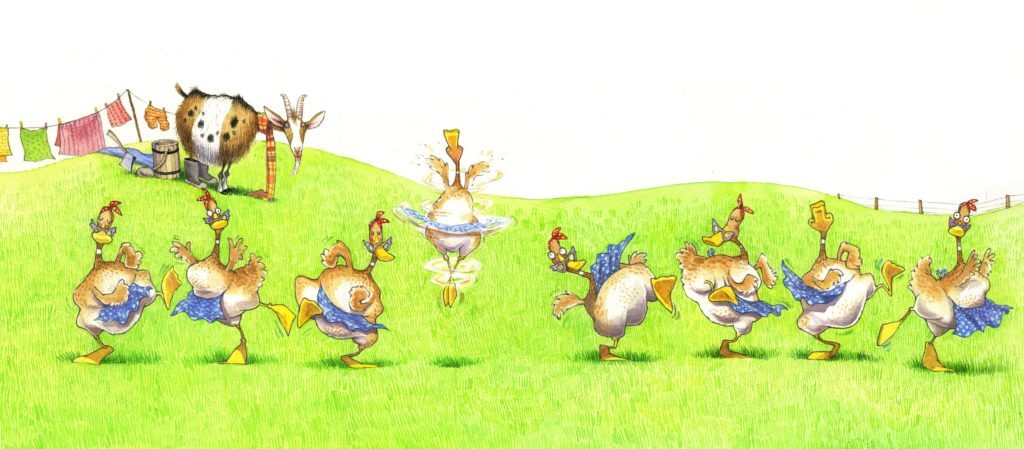
 The delight I feel in seeing these pictures every day is matched by the pleasure I feel every time I unwrap a new parcel of review copies. While writing this, I unpacked Gavin Bishop’s Wildlife of Aotearoa, which uses five eels to tell the story of our natural history. It’s not just that Gavin’s designs are striking; I’m also amazed at people’s response to his art. I’m part of a Christchurch group, organised by Painted Stories, who gather regularly to discuss picture books. When I brought out Wildlife of Aotearoa, there was an audible gasp from the others and they reached out with excitement and anticipation, then turned each page with satisfied exclamations. What impressed them was the way the illustrations drew them into each topic.